


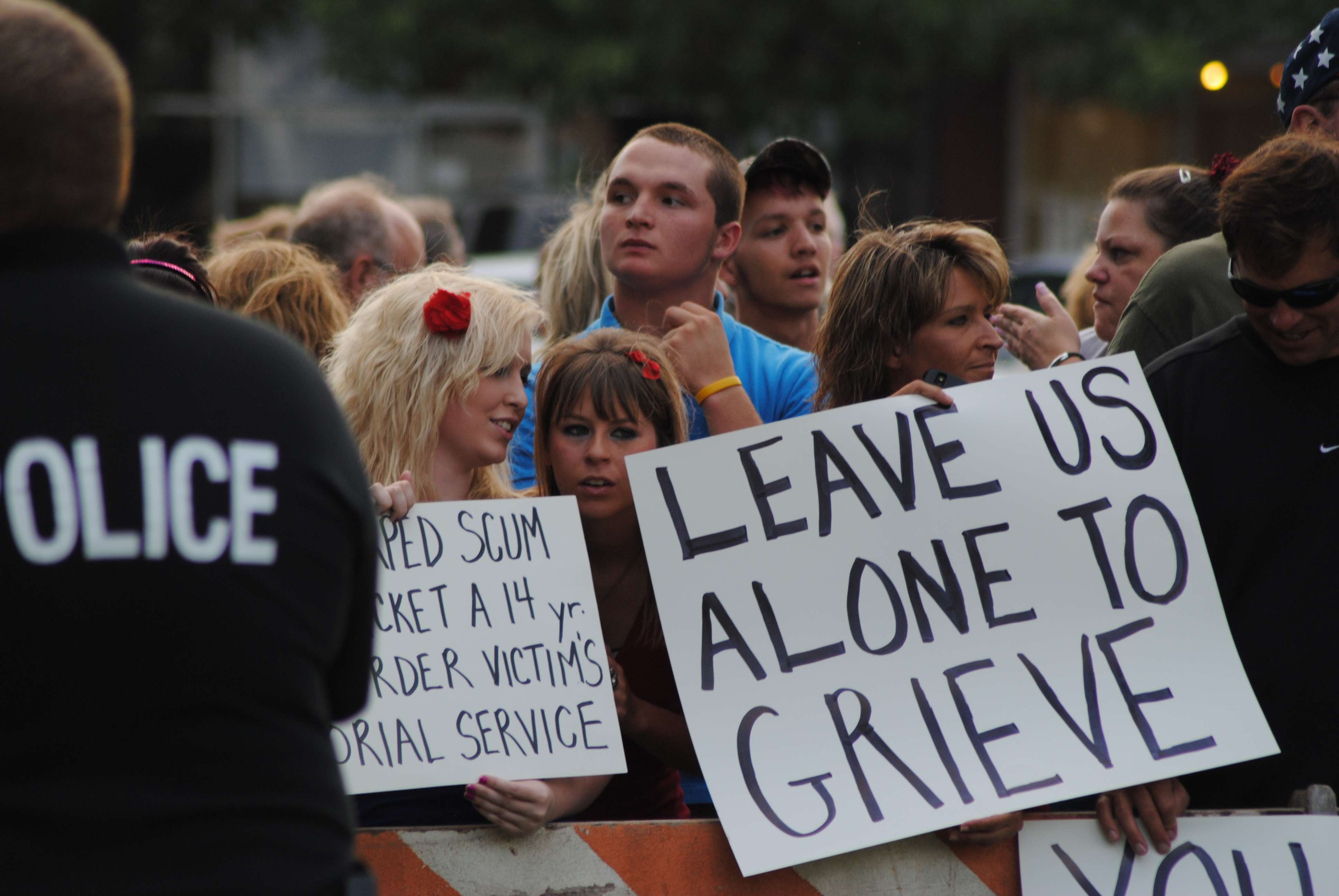
(Writer's note: The First Amendment's protection of freedom of speech is a fundamental American right, including the right to protest. While the group discussed in this story has a right to protest, it will not be identified by name. Former City Attorney Bob Suelter recently appeared on KVGB 1590/95.5's "Pages in Time" program with Steve Webster to share some behind-the-scenes details about a 2010 protest in downtown Great Bend).
By MIKE COURSON
Great Bend Post
"Only warped scum would protest a 14-year-old murder victim's memorial service." Emotions in Great Bend were already riding high following the Aug. 22, 2010, murder of 14-year-old Alicia DeBolt. A public memorial service was scheduled at the Barton County Courthouse nine days later. An infamous protest group from northeast Kansas learned of the service and wanted to bring its emotionally-charged message to an already emotional town. Bob Suelter grew up down the street from the group and was serving as Great Bend's city attorney at the time. He became a go-between between the city and the group.
"When you get into a situation like this, you have to ignore whether you agree or disagree with what they're saying," Suelter said. "You have to be in it for public safety, to keep innocent people from getting hurt, to keep people who are provocative from getting hurt, and to try and get this over with and not have anybody get hurt."
The group originally contacted then-Chief of Police Dean Akins, who approached the city administrator and Suelter about the group's wish to protest at the memorial. Suelter understood the right to protest but also his own community's desire to grieve.
"I thought, well, this memorial service is at the bandshell," he said. "I thought if they set up on the front entrance on the west side of the courthouse, that would get them further way. I was afraid they'd want to be real close."
The group did not want to be that close. Instead, they were to be staged in the northwest corner of Jack Kilby Square. Akins was out of town that evening and Great Bend Police Captain Bob Robinson took the lead, securing barricades from the city street department to set up an area of control. The protestors would be set up in the smallest area, followed by a buffer zone filled with police officers, then potentially angry crowd of mourners.
"They had arranged for some security on the outside, and that was the Sidewinders MC," said Suelter. "You would not think they would not provide security, but they did a heck of a job. I was amazed. Mike Urban was the president of the club at hte time. He did a heck of a job of getting the guys organized and making sure they stayed calm."
Across the street, riot guards from a nearby prison remained hidden from sight inside the Barton County Sheriff's Office. Their presence was never required as local law enforcement helped keep the peace.
"(The protestors) didn't want to be attacked," Suelter said. "They just wanted everyone's blood pressure up around 200, which worked on me because I think mine was up there around 200 when this was over."
The protestors arrived in Great Bend that evening and met Suelter and Robinson at the Casey's General Store on East 10th Street. Despite their message, Suelter recalls the small group of protestors having a friendly disposition. A plan was secured and the protestors arrived in a van parked on the north side of the courthouse.
As the protest began, the crowd outside the barriers grew to four, five, and six people deep. Suelter kept his eye on the crowd and could not see what was going on behind him.
"You could tell the crowd was picking up, so there was something going on behind me," he said. "They had a group of signs, then one lady had an American flag around her neck. The crowd was booing, and they would get louder. The police being there, and the courtesy and decency of the people of Great Bend, nobody got out of hand during the actual event."
The crowd's agitation continued to grow, and soon people were moving. He knew he would be a mere speed bump should the crowd decide to attack the protestors. He believes the protestors knew they had accomplished their mission and knew it was time to leave town.
"It was an interesting crowd because nobody got out of hand," said Suelter. "I was so happy and, really, so proud of Great Bend. The people came to show their displeasure with what these people stand for and what they were saying and doing, but they didn't become violent in the sense that they didn't hurt anybody."
The evening was not finished, however. As the protestors retreated to their van, a Great Bend resident kicked the back window out of the vehicle. The protestors were able to back out and flee the area, running the stoplight at Broadway and Kansas as they headed east.
"They weren't even out to the Bypass when my phone rang," Suelter said. "It was the guy I'd been talking to and coordinating the whole thing with. He said, 'We'll prosecute. We have a back window broken out. We see you guys have the person down, and we have it all on video.'"
Suelter said the resident responsible for the damage was later prosecuted and paid the protestors restitution for the window. There was also a public sentiment that evening to post the man's bond and get him out of jail.
Suelter, who stood between the protestors and the angry crowd, said he never feared for his own safety but did fear the agitators might accomplish their mission of making bigger headlines.
"I was concerned about people getting out of control," he said. "I wasn't concerned about them hurting me. I was concerned about them hurting the (protestors), and I think the police officers were, too. In another time, another place, I might have been one of the people yelling at (the protestors). But I felt it was my job to do this and be the operator of the whole thing."
The situation also gave Suelter a deeper respect for the law enforcement officers who were also tasked to provide security for a group they disagreed with.
"They have to stand there and take it for somebody else," Suelter said. "That's kind of the way it was going. None of the people there, that I know of - none of the officers there - would probably agree with what the (protestors) stood for, but they were all willing to stand out there and defend their right to say it."
Adam Longoria was convicted on several charges, including the murder of DeBolt, in April 2012. That June, he was sentenced to life in prison without the possibility of parole.