


By MARTY KEENAN
Special to Great Bend Post
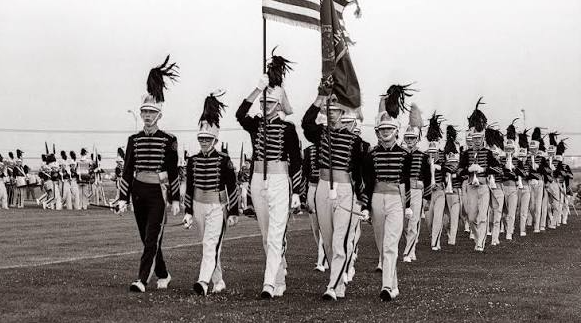
Great Bend’s American Legion post was founded mostly by veterans of Company C. 137th infantry during World War I. They distinguished themselves in the final battle of the war in the Argonne Forest, led by General Pershing. The Argonne Forest at Veterans Memorial Park in Great Bend honors those soldiers who helped win the Great War. The legendary Argonne Rebels Drum and Bugle Corps, which won the American Legion National Championships in 1971 and 1972, was named in their honor.
The war ended on the 11th month, of the 11th day, at the 11th hour by Armistice on Nov. 11, 1918. The original Nov. 11 holiday celebrated the Armistice that halted the fighting between Germany and the Allies at 11 a.m. on Nov. 11, 1918. The date was changed to Veteran’s Day in 1954.
The Great Bend soldiers first showed their bravery at Landersbach, Germany on July 20, 1918, in a raid of German trenches protected by barbed wire. Three Great Bend soldiers were decorated for bravery in that successful raid: Emil Rolf, Paul Masters and Louis R. Scott. Scott barged through German barbed wire and captured five German prisoners, as the Americans routed the Germans in spite of continuous machine gun fire. One Great Bend soldier died in that battle, Leo O. Varner.
War hero Louis Scott was a close friend of Price Bondurant, a Great Bend hardware dealer who lived at 2320 Broadway in Great Bend. His daughter, Joan, was an OSS spy in World War II and met Gandhi and became a pioneering nonviolence scholar. The Joan V. Bondurant Collection at the University of Rochester contains a letter from war hero Lt. Louis R. Scott, 7th Army Corps, second lieutenant, to Joan’s father. The postwar letter dated Dec. 22, 1918, from Wittlich, Germany commented on the victory celebration in Great Bend. The Spanish flu epidemic of 1918 did not prevent Great Bend residents from celebrating at the town square.
Scott’s letter offers a vivid connection between Great Bend’s celebration and the experiences of an American serviceman overseas: “I am told about the celebration in Great Bend when it was known for certain that the Armistice was really signed,” the serviceman wrote. “Having lived in Great Bend for a time, I can imagine just what sort of celebration it was.” He wrote that the American Expeditionary Forces would have staged an even greater celebration if they could have gotten hold of the Kaiser himself. Kaiser Wilhelm II, the Emperor of Germany, stepped down two days before November 11. In the Great Bend celebration, the Kaiser was hung in effigy.
Scott’s account of the moments before the Armistice was especially striking. Unable to get away to celebrate, the men could hear the artillery and feel the earth shaking. Scott wrote that as the time to cease war approached at 11:11 a.m. on Nov. 11, 1918, the Americans didn’t want to bring any ammo back home: “There was just one continuous roar of guns going night and day,” he recalled. “At that time we were not very far behind the lines and could get the full benefit of it and could feel the ground shaking all the time” In his account, they kept firing until one minute before eleven.
American soldiers were idolized in Europe
The letter also conveyed pride in service. “There is nothing to be more proud of than to be an American soldier in France, at least that is the way I look at it,” he wrote. He described French families offering American officers the best rooms in their homes and treating the soldiers with admiration, even when they had little else to give. “American soldiers in France now are idols since they showed the others what they can do and nothing is too good for them. The people treat us like little kings, although they have very little to treat us with except admiration.”
Scott also wrote: “Every evening we have a band, and they play the French national anthem (the Marseilles and the Star Spangled Banner.” Scott indicated that they made the captured German soldiers remove their caps when Marseilles the Star Spangled banner was played.
After the Armistice, Scott reported that he travelled to Virton, Belgium, close to the French border, where American military police rescued a German soldier who was being beaten by civilians. According to the letter, the German said the Americans were the only ones who would treat him kindly.
The men from Barton County were Kansas National Guard members, who joined a group from Burlington, Kan. to form Company C. They went to Oklahoma for training then by ship to Liverpool, England before being sent to battle.
Many of those from Barton County who gave the ultimate sacrifice died in the Argonne Forest in Northeastern France in the Meuse-Argonne offensive, fought Sept. 26- Nov. 11, 1918. It was the largest military offensive of the war that forced Germany to surrender. General John J. Pershing led the battle.
Those from Great Bend who gave their lives in the World War I are, to wit:
Forrest Allen – U.S. Army (died September 16, 1918)
Henry Brown – U.S. Army (died September 28, 1918)
Roscoe Chapman – U.S. Army
Leonard Crandall – U.S. Army (died October 23, 1918)
Fred Randall – Company C, 137th Infantry Regiment (died September 29, 1918)
Leland L. Ream – Company C, 137th Infantry Regiment (died September 28, 1918)
William F. Scheuffler – Company C, 137th Infantry Regiment (died September 30, 1918)
Alva L. Sloan – Company C, 137th Infantry Regiment (died September 28, 1918)
William E. Sloan – Company C, 137th Infantry Regiment (died September 26, 1918)
Leo O. Varner – Company C, 137th Infantry Regiment (died July 20, 1918; interred in Great Bend Cemetery)
________
Lawyer and author Martin J. Keenan recently published a book by Joan Bondurant called BONDURANT: The Spy Who Cracked Gandhi’s Code (2026).