


By ELLE HUTCHINSON
Barton County Media Consultant
For voters, Election Day may feel like the finish line. For the Barton County Clerk’s Office, however, there is still plenty of work to be done.
Kansas law sets the requirements for how elections are conducted before, during and after Election Day. Before an election, the County Clerk’s Office prepares ballots, deploys voting equipment and trains poll workers. Once voting is complete, the focus shifts to counting ballots, conducting required audits, completing the canvass and meeting deadlines established by the Kansas Secretary of State’s Office.
Bev Schmeidler, County Clerk/Election Officer, said there are three types of election reviews: post-election audits, close-race audits and recounts. The audits are mandatory and automatically triggered. Recounts, however, are initiated by a candidate.
Post-election and close-race audits are required when certain conditions are met. Recounts, however, are requested by a candidate.
On Nov. 4, the Kansas Secretary of State randomly selected races that must be included in each county’s post-election audit. Those selections included one federal race, one statewide race, one legislative race, one county race and the constitutional amendment.
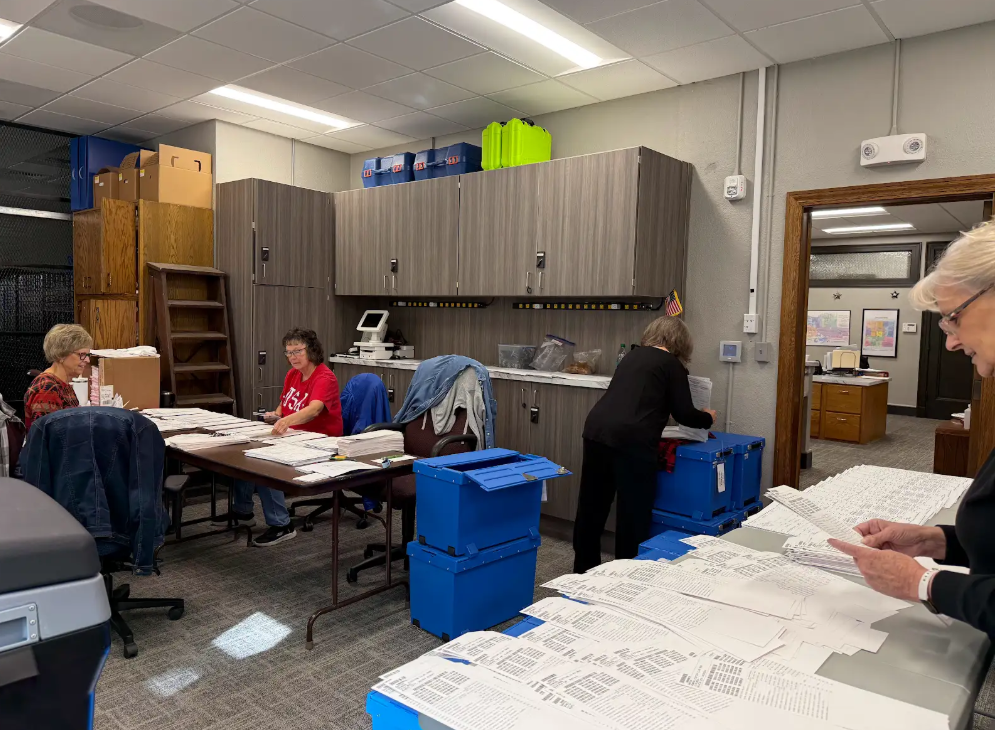
After the races are announced, each county randomly selects the precincts that will be audited. In Barton County, ballots from the selected precinct are then counted by hand and compared to the results recorded by the voting equipment.
The hand count is completed by a sworn, bipartisan election board that is independent from the regular election process.
In Barton County, the precinct selection process includes a familiar local tradition. Schmeidler prepares slips of paper for the eligible races and precincts, and Phil Kepka, an employee of the Barton County Appraiser’s Office, draws the selections from a can Schmeidler keeps specifically for elections.
Barton County has 41 precincts, meaning one precinct is selected for each race for the stand post-election audit. There is one additional requirement: the selected race must have at least 25 votes in that precinct. During this year’s selection, one race was drawn with only 21 votes, requiring Kepka to draw again.
A close-race audit requires an additional level of review. If a race falls within the threshold established by state law, an additional 10 percent of the county’s precincts must be audited for that race.
For the Nov. 3 General Election, Barton County will conduct close-race audits for the Governor, Secretary of State and Attorney General races. Schmeidler said the additional audits mean the audit board will work through every ballot box necessary to meet the statutory requirements and verify the county’s results.
Barton County’s post-election audit team includes Char Engleman, Mary Jane Felke, Bonnie Dirks and Jill Boultinghouse. The bipartisan board is also experienced, having completed a smaller election audit in August.
Schmeidler emphasized that these audits are intentionally conducted by local citizens who are not otherwise involved in administering the election, aside from casting their own ballots.
All of this is done, including the canvass, in the name of transparency. We absolutely want our voting public to know that ballots are correct, that our tabulators are counting accurately, and that votes are counted in compliance with Kansas law. Those votes hold our future and our office is committed to exceeding public expectations, Schmeidler stated.