


By MIKE COURSON
Great Bend Post
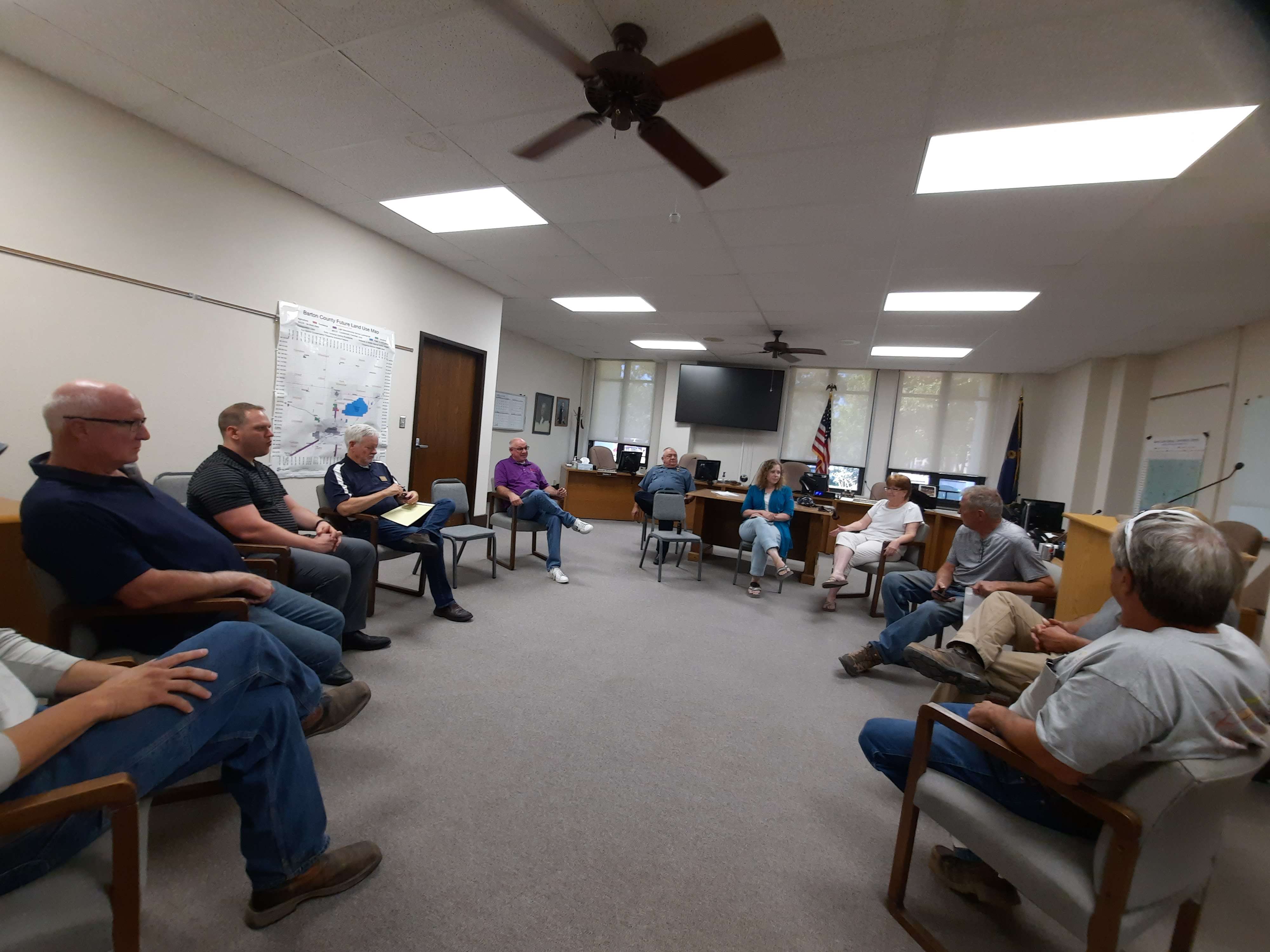
The three outgoing Barton County Commissioners are not turning the light off on their terms just yet. Thursday afternoon, Kirby Krier, Jon Prescott, and Jennifer Schartz met with representatives from Wheatland Electric, P&S Electric, the city of Ellinwood, and Barton County Sheriff Brian Bellendir to discuss the possibility of using solar panels to offset electrical costs. The consensus: much more planning is needed.
The panels would affect the Barton County Courthouse and the jail which, given their size and workload, consume a lot of energy. Many changes are coming to the courthouse in the near future with the installation of a new HVAC unit, and Schartz wondered if the space available would provide for enough panels to be beneficial to the county.
"I think that would be really a first step is to see, if everything were golden, how many could we put up there, and is it enough to go forward on?" Schartz asked.
Mark Kircher, project manager for Wheatland Electric, said the county paid $1,500 for a demand charge last month alone at the courthouse. That is just for the upsized equipment needed for peak usage. Any amount of solar power conducted could help lower that cost. Kircher also reported the 2021 peak was in October at 139 kilowatts, and the peak this month has been right around 100 kilowatts. Law allows for up to 100 kilowatt of generation via solar power, but space might not.
P&S Electric representatives gave a rough estimation that a 400x150-foot area of panels would be required to generate that much energy. Those 60,000 square feet could be divided in any number of ways. Purchasing just the panels to generate that much energy would cost the county some $200,000.
The county is also limited in its use of property, which extends just one foot beyond the actual courthouse. The city of Great Bend owns the remainder of the property. One suggestion was to put cover over the seats at the bandshell, then the county could use solar panels on the roof. The benefit to the city would be shaded seating.
All agreed there are too many variables to get close to actual figures for a project. P&S Electric will provide the first step by measuring the available space on top of the courthouse so that number can be relayed to Orazem & Scolara Engineering (OSE), which is doing the HVAC renovation.
"Once these guys get us a theoretical number and we can pass that on to OES, then we can have them start looking at the structure," Schartz said. "At least we have step one and step two."
Krier said the future of the project may depend on the county's ability to get a grant to cover costs.
Other items of discussion included:
- The county generating some of its own energy, especially during hours of peak usage, could yield savings for other energy consumers.
- The county's ability to utilize geothermal energy as part of the upcoming HVAC renovation was hampered by lack of ownership of the property surrounding the courthouse.
- With solar panels installed, the county would become an energy producer but selling any extra energy is likely implausible, as are batteries to store leftover energy. Any excess energy would therefore be donated to other customers around the area.
- New solar panels do not require direct exposure to generate power. They can generate power even if parts are shaded and even at night. They will not work in the event of a power outage.
- Solar units rated at 100 kilowatts may only produce that max for short periods of time. Something as simple as a passing cloud can drastically reduce production.
- New panels require little to no maintenance. Hosing off the panels once a year can increase power production by up to 10 percent, and debris like bird droppings can hamper production.