



Late summer is an excellent time for herbicide applications to control Phragmites, or common reed, which is a perennial plant that is increasing in Kansas waterways, wetlands, and roadsides.
There are actually two subspecies of Phragmites in Kansas: a non-invasive native species and an introduced species that is considered a noxious weed in Nebraska and Colorado, but not in Kansas. Some key characteristics that distinguish the non-native species are:
· Dense, monoculture stands with many standing dead stems (native stands have more plant diversity and fewer dead stems).
· Rough, green stems (native stems are smooth, glossy, and rose/red in the lower part of the plant).
· Leaf retention after senescence (native leaves are easily removed and often dropped from stems).
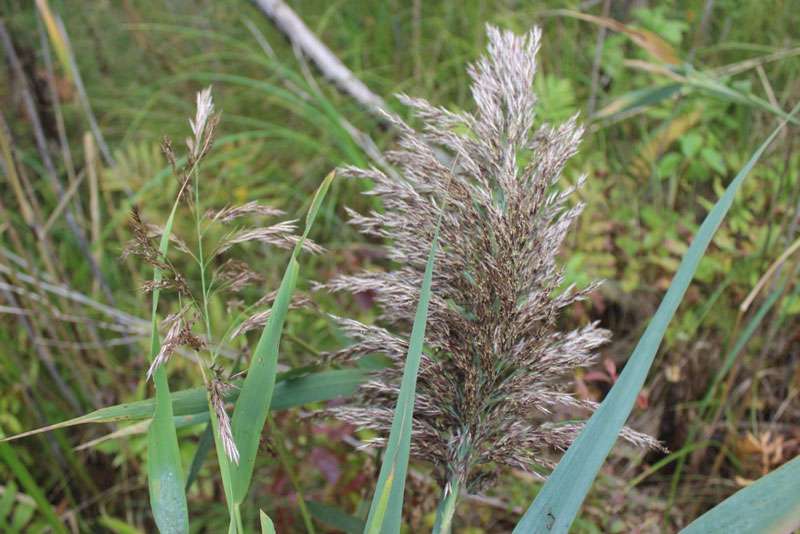
Management Options
Prevention, proper identification and early detection are the most effective measures to manage the plant. There are no recommended biological control methods at this time.
Mowing is one method to manage non-native phragmites but it should be done several times during the growing season to be effective. Mowing alone will not provide control.
Both intensive grazing or prescribed burning alone will not control non-native phragmites. Both will remove top vegetative growth, but both should be used with other management measures.
Herbicides are generally the most effective means of controlling Phragmites. The best time for application is after the plant stops using energy to produce seeds and begins to prepare to overwinter by translocating carbohydrates to the rhizomes (late summer/fall).
Because Phragmites is a perennial plant, multiple applications will likely be needed to completely kill the rhizomes, especially in large, well-established stands. Herbicide and surfactant options are often limited due to the need for an aquatic application label. The two products most commonly used with an aquatic label are glyphosate (Rodeo, others) and imazapyr (Arsenal, others).
Some experts say that spraying herbicide on mature plants will have less than desired benefits. Another herbicide treatment approach is to cut as much of the Phragmites as possible a couple of inches above the water line. If possible working in small stretches so that there is no more than 15 minutes between cutting and herbicide application and to continue this process. Monitor regrowth of surviving plants as repeated herbicide applications may be required. Be sure to select a product labeled for the site. Read, understand and follow all label instructions when using any pesticide.
Imazapyr (Arsenal, others) can also kill tress in the treated area, as it is also labeled for control of hardwood brush and trees.
Treatment of aquatic weeds may result in oxygen depletion or loss due to decomposition of dead plants. This oxygen loss may cause the suffocation of some aquatic organisms/fish, etc. DO NOT treat more than 1/4-1/3 of the pond surface area of the water in a single operation and wait at least 10 to 14 days between treatments. Begin treatment along the shore and proceed outward in bands to allow aquatic organisms to move into untreated areas. DO NOT contaminate water when disposing of equipment wash waters or rinsate.
Aquatic applications can also lend themselves to aerial applications, typically by helicopter or drone, provided the herbicide label allows for aerial application. When applying glyphosate or imazapyr for control of Phragmites, care should be taken to avoid off-target movement and injury to desired species and follow the setback distance to water intakes.
The use of trade names is for clarity to readers and does not imply endorsement of a particular product, nor does exclusion imply non-approval. Always consult the herbicide label for the most current use requirements.
Information provided by Sarah Ganske, K-State Weed Specialist and Joe Gerken, K-State Extension Fisheries and Aquatic Specialist.