



Following wheat harvest, some producers may consider baling or even burning their wheat stubble--a practice more common southeast of us. Producers may consider burning for several reasons: as a management practice to control plant diseases or weeds, to improve the seedbed for the subsequent crop, and possibly for other reasons. While burning is inexpensive and baling provides additional income, producers should understand the true value of leaving crop residue in the field. Some of the information below comes from K-State Extension publication MF-2604, The Value of Crop Residue.
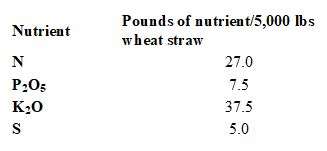
Loss of Nutrients - the products of burned wheat stubble are gases and ash. Nutrients such as nitrogen (N) and sulfur (S) are largely combustion products, while phosphorus (P) and potassium (K) remain in the ash. When residue is burned, about one-third to one-half of the N and S will combust. The nutrients in the ash may remain for use by the plants if it doesn’t blow or wash away first (more on that below). Therefore, instead of cycling these important plant nutrients back into the soil, they can essentially become air pollutants when the residue is burned. With the rise in price for nitrogen fertilizers, the amount of crop residue N that could be plant available in the future is worth more than in years past.
Table 1. Amounts of nutrients remaining in wheat stubble when assuming 50 bu/acre yield.
Protection from Soil Erosion - bare soil is subject to wind and water erosion. Without residue, the soil will receive the full impact of raindrops, thus increasing the amount of soil particles that may become detached during a rainfall event. Bare, tilled soils can lose up to 30 tons per acre of topsoil annually. In no-till or CRP systems where residue is left, annual soil losses are often less than 1 ton per acre. The detachment of soil particles can lead to crusting of the soil surface, contributing to greater amounts of sediment-laden runoff and, thus, reduced water infiltration and drier soils.
Leaving residue on the field also increases surface roughness, decreasing the risk of wind and water erosion. Most agricultural soils in Kansas have a “T” value, or tolerable amount of soil loss, of between 4 and 5 tons per acre per year, which is about equal to the thickness of a dime. To prevent water erosion, 30% ground cover or greater may be needed to reduce water erosion to “T” or less, especially in fields without erosion-control structures such as terraces.
Standing stubble is more effective at preventing wind erosion than flat stubble. Occasionally, accidental residue burns have resulted in devastating wind erosion events that recur until new ground cover is established. Once a field begins to erode from the wind, it is extremely difficult to stop. During an extended drought, the soil profile dries out, and even emergency tillage is ineffective at stopping wind erosion. Losing topsoil degrades soil productivity, and the long-term effects of this loss are difficult to quantify.
Soil Moisture, Infiltration Rates, and Conservation - wheat residue enhances soil moisture by increasing rainfall infiltration and reducing evaporation. Residues physically protect the soil surface and keep it receptive to water movement into and through it. Without physical protection, water and soil will run off the surface more quickly.
Ponded infiltration rates were measured at Hesston in September 2007. Very low infiltration rates (1.9 mm/hour) were observed for continuous winter wheat in which the residue was burned each year before disking and planting the following crop. In contrast, high infiltration rates (13.3 mm/hour) were observed for a no-till wheat/grain sorghum rotation.
Another way residue increases soil moisture is by reducing evaporation rates. Residue blocks solar radiation and cools the soil surface by several degrees in summer. Evaporation rates can decline dramatically when the soil is protected with residue. Research from dryland experiments has shown that crop residues are worth 2 to 4 inches of water annually in the central Great Plains states (Efficient crop water use in Kansas, MF3066).
Information provided by DeAnn Presley, K-State Extension Soil Management Specialist