


By MIKE COURSON
Great Bend Post
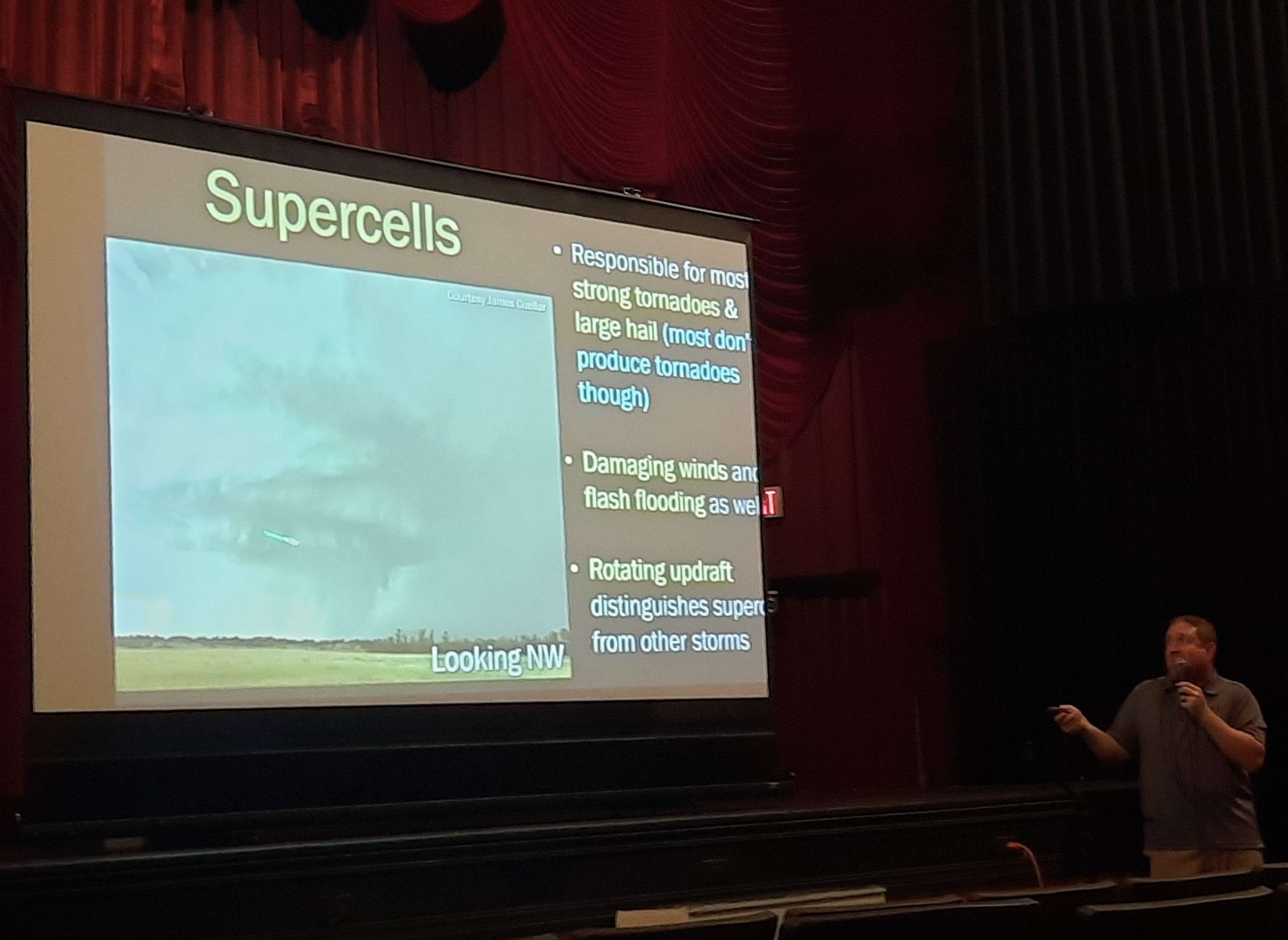
Like so many other things, severe weather seems to have slowed down with the onset of COVID-19. At Monday's "Storm Fury on the Plains" presentation at the Crest Theater in Great Bend, National Weather Service Forecaster Robb Lawson said severe storm numbers have been down over the past three years, but Kansas still leads the nation in severe weather activity.
"Despite it being below normal, we can't get complacent," he said. "We've been saying that for the last few years. Because even though it was a really quiet year, we still did have tornado events. You still do get tornadoes, even in quiet years. It only takes one really big tornado to really cause some damage."
Last year, the Weather Service issued 981 warnings for tornadoes, severe thunderstorms, and flash floods. That was down 376 from the average. Warnings numbers were 302 below average in 2021, and 349 below average in 2020. It's the lowest three-year count since 1992.
But, Lawson said, those numbers are likely to rebound. And when they do, the National Weather Service relies on spotters to relay information to the public. Radar technology has improved greatly over the last several years, but it still has limitations near the ground. The Weather Service can issue a warning based on radar, but they can add credibility to the warning with details provided by spotters.
"We can put that a tornado is already in progress; it's already doing damage," Lawson said. "To do that, we need spotters. Or maybe you have baseball-size hail. We can put that in the body of the warning. This storm has a history of producing baseball-size hail; it's coming into Great Bend. Please take shelter immediately."
Lawson also referred to the "cone of silence" around radar, or an antenna blind spot. Because cities like Wichita and Andover are so close to a radar station, the National Weather Service often uses the radar out of Vance Air Force Base in Enid, Okla., for predictions in those areas. Last year's April 29 tornado in Andover barely registered on local radar, making storm spotters all the more important.
Accurate reporting is also essential for keeping the public informed. Lawson outlined a few items the NWS always wants to know, including exact times and locations, which should reference nearby towns when possible since the Weather Service may not understand references to local roads. Reports can be made to the NWS via social media, with Twitter (@NWSWichita) being the preferred platform. Other reporting tips:
- Report size and whether or not hail is still falling. Use coin or ball references when possible, but keep references simple when relating size.
- Report any wind damage to trees and structures.
- Report any funnels or tornadoes. If you cannot see the funnel touching the ground or circulation on the ground, report that. Also, report if the funnel is still on the ground or has gone back into the clouds.
- Report any flooding water over roads, ditches filling, or submerged vehicles.