


By MIKE COURSON
Great Bend Post
Each fall, the best of the things that grow and live in Kansas are exhibited at the Kansas State Fair in Hutchinson. Ellinwood’s Wayne DeWerff has mastered the watermelon. This year, DeWerff won his fourth Governor’s Sweepstakes for his fourth win in six years. In those other two years, he finished runner-up.
“Until 2021, I had never won the Governor’s Sweepstakes, always finishing second or third in an 8-10 deep field of exhibitors,” he said. “That alone represents 32-40 melons in just one class. And that goes back to around 2003. As a judge myself, I often didn’t see it the way the official judge saw it, for I always credited uniformity of the four-melon exhibit as a major consideration. I’m sure they favored other criteria differently as well. Either way, I was convinced I would someday achieve the objective I sought.”
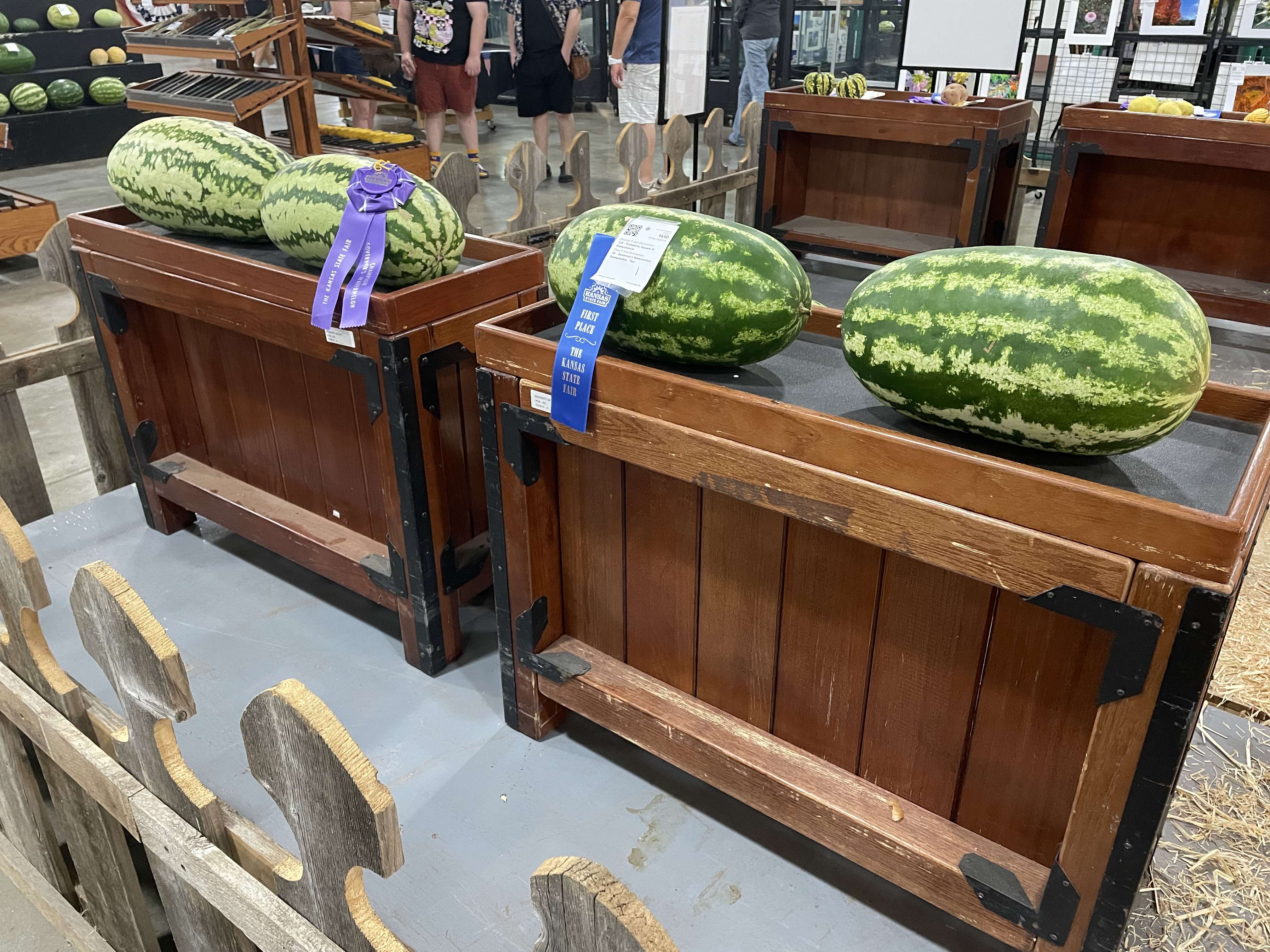
The are many classes to win at local county fairs and the Kansas State Fair, but the Governor’s Sweepstakes is widely considered the top award in the Open Class agricultural horticulture exhibits, especially in the watermelon division. The competition requires growing four exceptional melons of at least two varieties.
“It starts with selecting varieties that you’re looking for, which involves uniformity, shape, size, market quality, color, condition, and true to variety,” DeWerff said. “And obviously, one has to look carefully to avoid the scratches and scars, vine indentations, and ensure the bottom is the right color, indicating they’re ripe. It’s very difficult to find the ‘perfect melons’ and pair them up with three others nearly alike.”
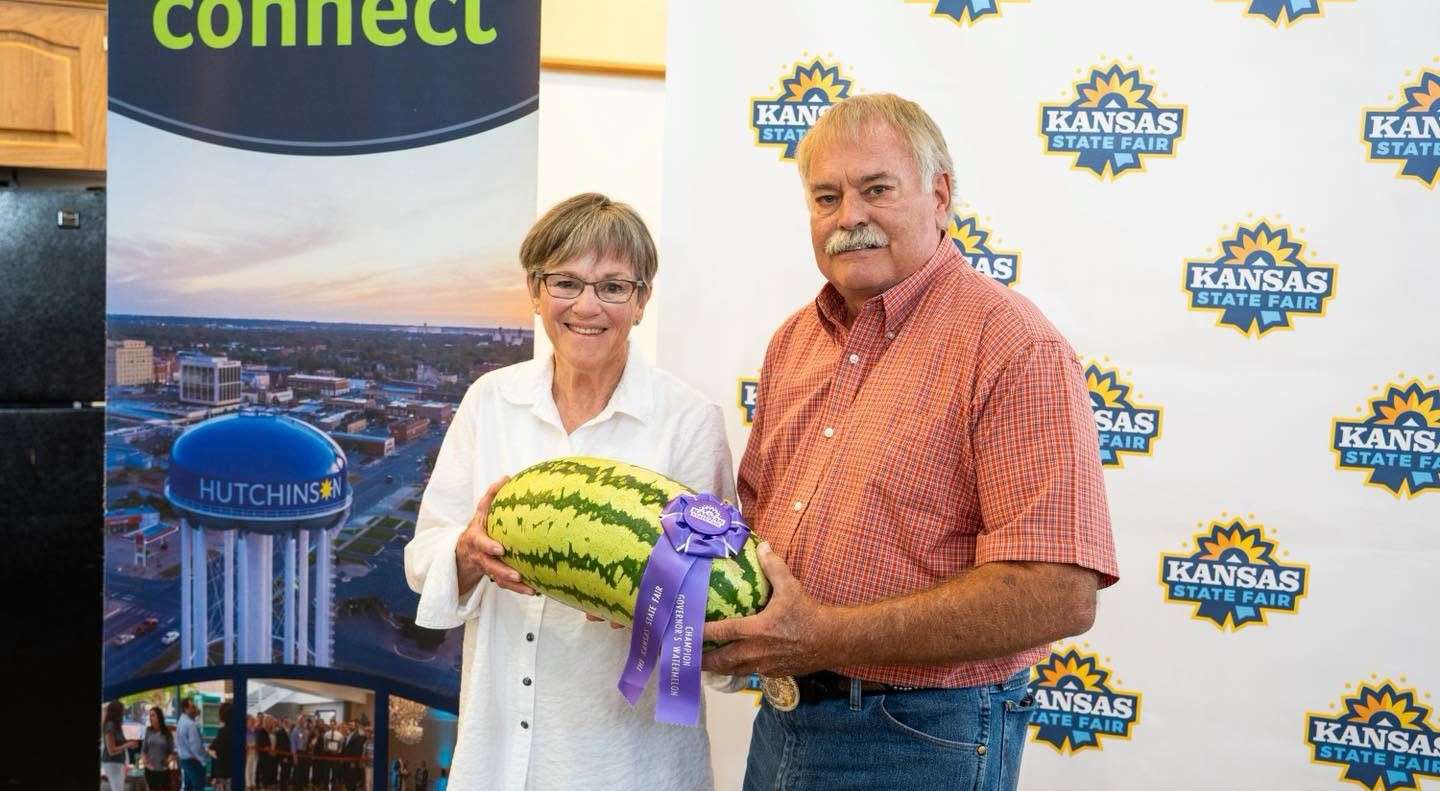
Along with the prestige of being a Sweepstakes winner, the honor includes the opportunity to present a melon to the governor, usually on a Thursday known as Governor’s Day. DeWerff has presented two melons to Governor Laura Kelly and two to Lt. Gov. David Toland.
“It’s definitely a lot of work, but I enjoy the process and challenge,” said DeWerff. “Hoeing has always been somewhat stress-relieving, and its fulfilling and personally satisfying seeing a weed-free row of melons. And then if all goes right, that 6-foot space between the rows fills in, shading weeds from making their appearance—at least until the melons get ahead.”
Picking an award winner is not as easy as grabbing the first melon in the row. DeWerff walks the patch with an eye for which varieties, in the right shapes and sizes, might match best for group classes, as well as for individual melons for those classes.
“At first, it’s very selective picking,” he said, “but shortly after, anything goes. Obviously the bigger and shapelier ones go first while allowing the smaller ones to develop and ripen as I go. It’s a lot like a process of elimination.”
Where it all started
DeWerff has been growing watermelons since he was six years old. Back then, the
job was to walk alongside his mother and father, counting out and dropping five
seeds in each hole, then covering them as they navigated a straight line down
the row.
“Upon getting to the three-leaf stage, we all would go back out to the patch and frame a shallow circle around the plant, adding a sprinkle of fertilizer to each,” DeWerff said. “Many hours were spent hoeing and pulling pig weeds, Kochia, and of course crab grass in an effort to keep the melons clean.”
In modern terminology, it’s called reducing weed pressure. DeWerff said watermelons tolerate pig weeds reasonable well, and the weeds actually shade the growing melon to help reduce sun scald, although they also compete for available moisture. Crab grass can outright choke a growing melon out.
The entire growing process was a family affair. When the melons began ripening, mom and dad did the picking while the kids carried the melons to the edge of the field for pick up.
“Our task wasn’t the easiest,” DeWerff recalls. “Sometimes the melons felt as if they weighed more than us. Those big Black Diamonds were often 40-60 pounds, and high-stepping your way around and through the vines was of utmost importance. I tripped many times and occasionally busted some, but dad and mom were very forgiving. We all gathered around to at least eat the hearts out before moving on. Indirectly, it was always a way to double check to see if dad’s thumping was accurate.”
Growing the melons was also a small business. The DeWerffs sold hundreds of pounds of watermelon from home, and more from the grocery store. Wayne provided a final quality check on the goods.
“We couldn’t wait to put the ‘Watermelons for Sale’ sign at the end of the lane,’” he said. “A job of mine was to wipe them clean and make sure there weren’t any puncture vine stickers on them, and then use my best penmanship to mark a whopping 50 cents on most. “Those were definitely the biggest ones, but for that matter, they were all big to me at that age.”
An ongoing family affair
Roles changed as the DeWerff siblings grew older. The family still planted
watermelons together, at least one member of the family could be found each
evening hoeing the garden, even if just for 30 minutes at a time.
“Us three boys were in the field much of the time, either bucking bales or cultivating corn and milo on a two-row cultivator behind a little Ford tractor,” Wayne said. “Evenings after milking and chores were done typically found us out while it was a little cooler.”
But it was not all work. The fun started once the kids were old enough to work unsupervised. Wayne’s sister, Diane, was a pitcher for the fast-pitch softball team. After a solid effort in the field, she would break out a softball, pitching to her brothers who used hoes as bats.
“There was one hoe in particular that was shorter than the rest, and that became our favorite bat until we broke it with a solid fly ball to the sixth row of Charleston Greys,” said Wayne. “Each base was a different variety of melon. We tried our best not to run over the vines, but that didn’t always happen. I didn’t tell that story to my mom until recently—what happened in the melon patch stayed in the melon patch!”
Still growing today
The DeWerffs hit the jackpot in 1971 when a new Crimson Sweet variety of melons
was developed at Kansas State University. The round-striped watermelons quickly
became the family’s best seller. The DeWerffs were able to raise their prices
but still managed to sell out every picking. To this day, Wayne continues to
plant Charleston Grey and Black Diamond variety, mainly because of their
prolific ability and notoriety.
“Today, the long-striped hybrids have come to the forefront,” Wayne said. “Rattlesnake, Jubilee, Pronto, and my favorite, Starbrite, have taken center stage as to their sweet flavor and attractiveness. But the investment is not without a higher price tag versus the old standard varieties.”