



I am writing a series of articles about the wheat streak mosaic virus complex. Last’s week article was an overview of the mosaic virus complex and how curl mites’ vector and spread the virus from volunteer wheat. This week’s article will be an overview of how critical controlling volunteer wheat is to lessen the burden of spreading the three different mosaic viruses.
There are two critical periods for volunteer control: immediately after harvest and prior to fall planting. Volunteer wheat present at harvest is the perfect place for populations of curl mites to migrate as the crop dries down. In addition to hosting curl mite, volunteer wheat also hosts aphids (transmit barley yellow dwarf virus) and hessian fly. Controlling this volunteer wheat as soon as possible will help dilute the mite populations heading into the remaining summer months. The second most critical window is pre-planting, as mites present at this time will migrate directly to the 2027crop.
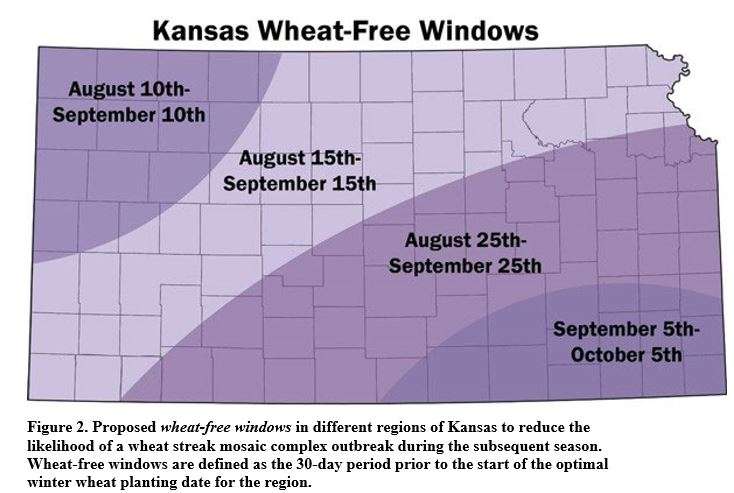
K-State Research & Extensions updated recommendation for volunteer wheat control includes regional recommendations for wheat-free windows--figure 2, formally known as (Hessian fly best pest management planting date). These windows include a period of 30 days prior to the start of the optimal winter wheat planting window by zone in Kansas.
As the wheat curl mite is a community pest, coordinated breaks in volunteer wheat will have the highest likelihood of lowering local and statewide mite levels moving into our 2026 optimal planting date periods. Volunteer wheat that emerges after the fall crop is already established poses a lower risk as a green bridge and can be thought of in a similar way as the fall crop. Fall wheat planted early during wheat-free windows risks bridging wheat curl mite to the fall-established crop.
Important considerations for achieving success with wheat-free windows:
All volunteer wheat should be terminated and completely dead prior to the start of your regional wheat-free window.
Where possible, the fall wheat crop should not be planted until the end of the wheat-free window.
· Other winter cereals (such as rye and triticale) should not be planted during this period as they can serve as a “bridge” for the curl mites to fall-established wheat
· A regional “break” in the volunteer wheat green bridge will allow for wheat curl mites to die off prior to the start of the optimal wheat planting window.
· Volunteer wheat that emerges after this period is of less concern, as it will be emerging at a similar time as the fall-established winter wheat crop.
· Success depends on coordinated efforts within communities.
Revisiting Herbicide Recommendations for Volunteer Wheat Management - the time it takes for wheat to die off after an herbicide application will influence the number of mites that persist and the ability of those mites to migrate off the slowly dying wheat. Research conducted at K-State in a greenhouse study revealed that curl mite populations three days after an application of paraquat where much lower compared to glyphosate, and after 6 days only a few mites existed from the paraquat treatment compared to 60 mites with a glyphosate treatment.
Glyphosate is the most recommended herbicide for volunteer wheat control in wheat stubble. While it is a very cost-effective option, it has a drawback in terms of managing the risk of wheat streak mosaic complex. Glyphosate takes up to two weeks to kill plants, which means wheat curl mite populations will continue to build on glyphosate-treated volunteer wheat. Furthermore, the mites will have sufficient time to migrate to the tops of plants and assume a “dispersal posture” after a glyphosate application. Herbicides that act more rapidly, such as paraquat, are more effective at managing the wheat curl mite populations. Another option to increase the rate of desiccation would be to include saflufenacil (Sharpen) or tiafenacil (Reviton) in the glyphosate application.
Adding an herbicide with residual activity will also be helpful. Products that will control or suppress volunteer wheat include atrazine, metribuzin, and sulfentrazone (Spartan). In addition to providing residual activity, atrazine and metribuzin can be used to enhance paraquat activity.
Stacy Campbell is a Crop Production Extension agent in the Cottonwood District (which includes Barton and Ellis counties) for K-State Extension. You can contact him by e-mail at scampbel@ksu.edu or by calling 785-628-9430.