


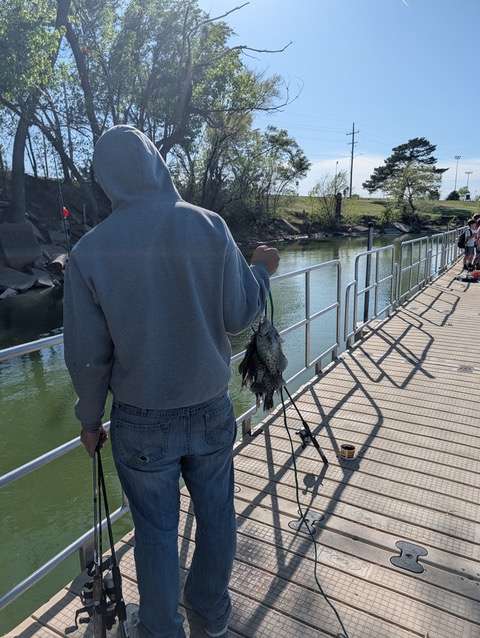
In between the serious talks about the importance of education and planning for his future, a 16-year-old Barton County boy is finding a balance by participating in activities through the Juvenile Services (JS) mentoring program.
He is on supervised diversion in the JS Immediate Intervention Program as the result of a low-level misdemeanor.
“It is important for kids to think about the future, while making the time to do the fun things they enjoy,” the teenager said. “This is a good way to stay out of trouble and then have a good future.”
Some of the topics he discusses with his JS mentor are schoolwork, employment, salaries, goals and “what you have to do to get the outcome you want for future success,” he noted.
Activities so far include disc golf, cornhole, fishing, puzzle-building, barbecuing, day school, and juggling solo and in a group.
“These talks and activities help me stay busy and keep me out of trouble, while I start to think about the future and getting a job. Eventually, I want a good job that I like so that I will stick to it.”
Mike Daniel
Mike Daniel, JS assistant director, said a goal of the mentoring program is “to form positive relationships with positive experiences. And you hope it is contagious. From what I have seen during this first year of the program, many clients are meeting these goals – including the teenager sharing his story.
“We want to encourage young people to get out and do something instead of just playing video games, staying up late and sleeping late. The idea is to get out of the house and actually let the sunshine hit your skin.”
This is important because physical health and mental health go hand-in-hand, Daniel explained.
“Where the mind goes the body follows, and vice versa. For example, hiking, biking, shooting hoops or helping with community-service work can be so important to someone’s outlook on life.
“These activities can help a young person be more receptive to weekly visits with me or other mentors to discuss college and vocational-technical courses. It then comes naturally to discuss career opportunities.”
Daniel acknowledged that he sometimes has to “strongly encourage” a client to get involved in conversations and activities. “But once they participate, they end up enjoying themselves.”
Motivational interviewing
Motivational interviewing, which often involves a what-if scenario, is a big part of the mentoring program.
For example, when a young person is asked: what will happen if you drink alcohol? Answers could be: have an accident; police involvement; or a penalty for breaking curfew.
“We ask them to play the tape forward,” Daniel summarized.
Daniel and his colleagues also try to determine what triggered a bad decision. A trigger can result from a feeling of being powerless, disrespected, ignored, unloved or manipulated.
The best way to start the conversation is with open-ended questions or comments; closed-ended questions oftentimes yield one-word answers.
For instance, a young person may say “okay” when asked how their day is going. But if the conversation starts with “tell me about your day,” the teenager may open up a bit.
“And then we ask them to elaborate,” Daniel commented. “This results in more of a give-and-take.
“The practices we use in mentoring are evidence-based; research demonstrates that they work. They help reduce recidivism, which is one of the main goals of mentorship.”
20th Judicial District Juvenile Services empowers youth in Barton, Rice, Ellsworth, Stafford and Russell counties to achieve positive outcomes by offering Juvenile Intake & Assessment, Immediate Intervention, Intensive Supervised Probation, Case
Management, Journey to Change, Life Skills, All Stars and Youth Crew. Parents and guardians also are offered The Parent Project. Visit 1800 12th in Great Bend or call 620-793-1930.