


In recent years, Leonard Kaiser has visited with many farmers and ranchers, along with those who interact with them, offering information about mental health and suicide risks.
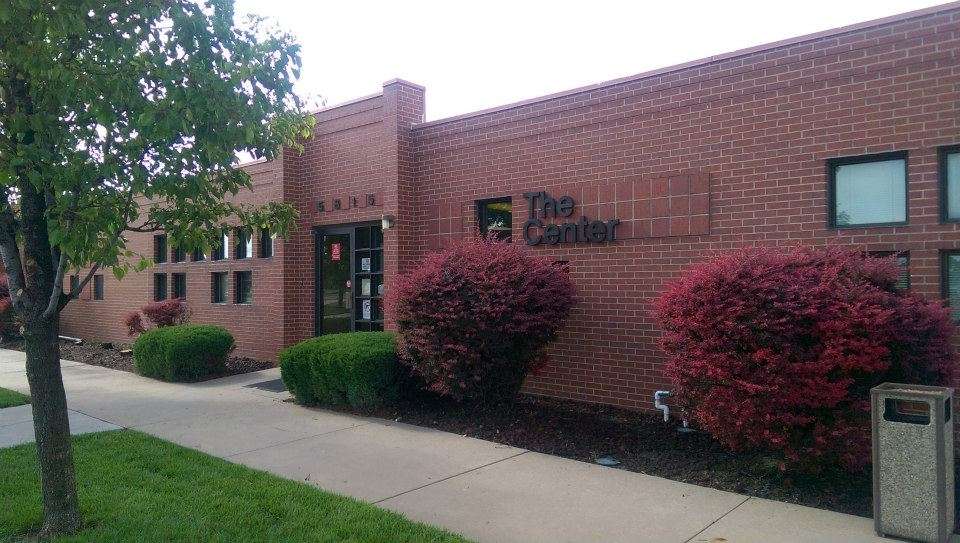
As community liaison at The Center for Counseling & Consultation, 5815 Broadway, Kaiser is now intensifying those efforts.
“We are working more closely with Kansas Ag Stress and AgriSafe,” explained Kaiser, a licensed clinical professional counselor. “The resources they provide focus on education for those who work in agriculture.”
For example, Kansas Ag Stress notes that farmers and ranchers are the backbone of the state, providing crops, livestock and dairy products.
“Unfortunately, the stress that comes with these responsibilities can be overwhelming,” its website states. “Unpredictable weather, heavy workloads and financial worries can sometimes take their toll … and lead to mental and emotional distress, substance abuse, anxiety, depression and even suicide.”
AgriSafe, which offers a helpline and live chats, is trying to replicate a program that is showing promise in Europe.
“This program is modeled on the substitute-teacher system,” Kaiser commented. “If a farmer is facing surgery or serious illness, volunteers handle things on the farm until the owner has recovered.”
Local presentations
Kaiser, who has a farming background, is available to any group interested in learning more about mental health on the farm. His presentations last about an hour.
“However, I was invited to speak at a coop meeting and covered the basics in about 15 minutes,” Kaiser recalled. “We just want to get the word out to anyone who wants to hear it.
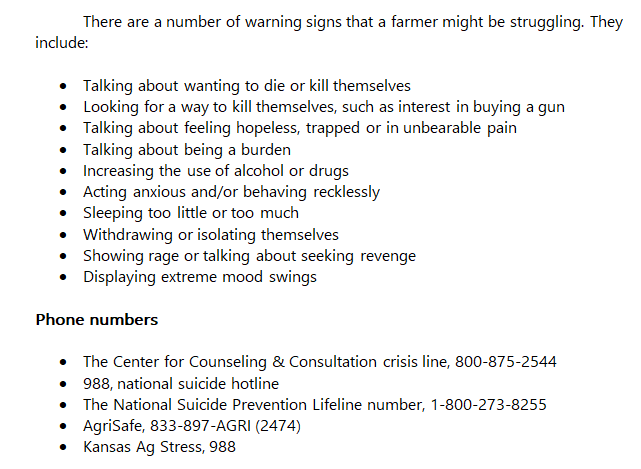
“This is really important for family and friends who see the farmer on a regular basis. When they are concerned about their loved one, we can help identify certain behaviors to watch for.” (See sidebar story.)
Mental-health discussions are especially important now that the average age of a farmer is 58. “And the next generation isn’t taking over the family farm,” Kaiser noted. “Some sell the land to cover debt, while others lease their ground.
“Either way, they look at themselves as the generation that lost the family farm. With all the uncertainty and costs to produce a crop, they get to the point where they say ‘I just can’t do this anymore.’”
Kaiser realizes that farmers oftentimes don’t want to meet a counselor in person. “If this is the case, they can use telehealth services at home or even in the tractor.”
He said The Center is fortunate in that coops and other ag-related entities are open to his efforts to provide education and resources.
“Five years ago, the response might have been different. Now, I hear that people are absolutely open to talk about this. The stigma is still there but it is getting much better.”
Jeff Mauler, American Plains Coop chief operations officer, agreed that “more farmers are open to these discussions today because there is more awareness. Some farmers might feel like a failure and they have no control over anything. The pressure stacks up.
“And sometimes the signs of mental-health issues go undetected because farmers can mask it pretty well. After all, they are the big, tough guys that can handle anything.”
The importance of raising awareness and reducing the stigma is being demonstrated locally more than it used to. “For instance, I know of an informal network of farmers who make it a point to check in on friends and neighbors who they worry might be struggling,” Mauler noted. “It could be a phone call or visit – just to say ‘how ya doing.’”
Kaiser asked if Mauler would display posters and brochures that encourage people to seek advice or dial 988, the national suicide hotline. Mauler didn’t hesitate; these resources are at American Plains’ 15 locations now.
Mauler acknowledged that he was skeptical about the seriousness of mental-health concerns a few years ago. “Then Leonard and The Center came to us with information. They brought these issues to the forefront and we appreciate it.”
The Center for Counseling & Consultation, a Certified Community Behavioral Health Clinic, 5815 Broadway in Great Bend, serves Barton, Pawnee, Rice and Stafford counties. Professionally trained personnel offer: individual and group therapy; marriage and family counseling; community-support services; community-based services; psychosocial rehabilitation; peer support; and medication management. The confidential 24/7 crisis hotline number is 800-875-2544.