


By DALE HOGG
Barton County Media Consultant
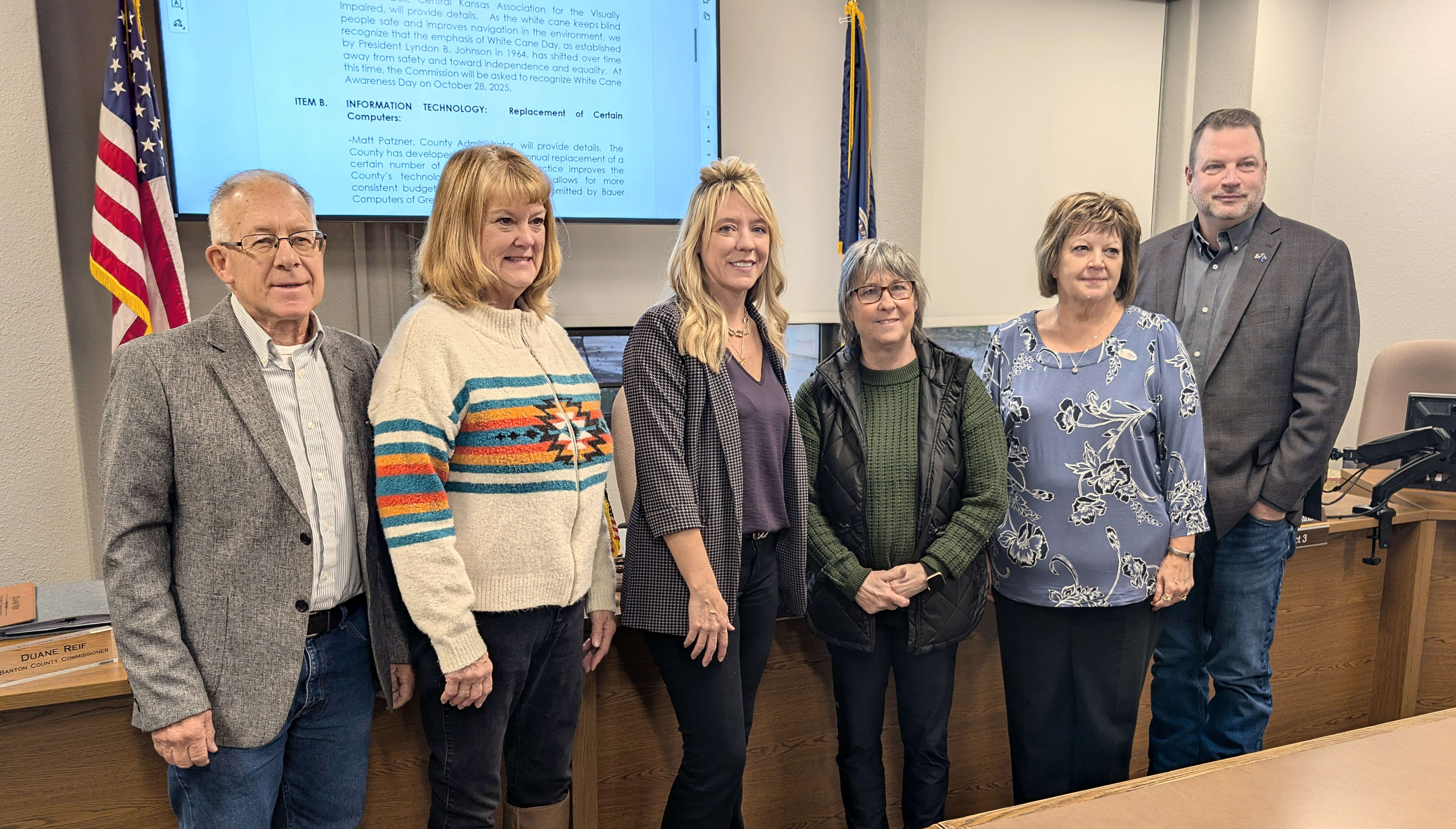
The white cane is a symbol of freedom for the visually impaired, Sharna Doll told the Barton County Commission on Tuesday morning as the commissioners adopted a proclamation recognizing Tuesday as White Cane Awareness Day.
The action followed a request from Doll, who spoke on behalf of the Central Kansas Association for the Visually Impaired. Doll addressed the commissioners, explaining the significance of the white cane and the history of the annual observance promoted by the National Federation of the Blind, and noted the observance is not as well known as it should be.
While the cane's initial purpose was safety and improved navigation, Doll noted that the emphasis of White Cane Day, established by President Lyndon B. Johnson in 1964, has evolved.
"We recognize that the emphasis of White Cane Day has shifted over time away from safety and toward independence and equality," Doll said.
The group previously marked the day by walking around the courthouse with their canes, but "we can’t really do that anymore because a lot of our members are too old," she said. Doll, who is 63, noted the age range in the group is wide, with members as old as 92.
In an effort to increase awareness, she is actively trying to get more younger people involved.
The group, which meets on the fourth Monday of every month except November and December, also serves as a support network and regularly hosts speakers. They also advocate for safe sidewalks and other improvements, and mental health care to help those with a vision impairment.
The proclamation calls on citizens to acknowledge the independence of the blind and visually impaired and to understand the white cane's symbol. The proclamation also honored members of the Central Kansas Association for the Visually Impaired for its community efforts.
The white cane, introduced in the 1930s, is a vital tool that "expands [the visually impaired's] effort" to explore the world using hearing and touch, she said.
"It allows for a longer reach so that visually impaired people can more easily assess situations, and move quickly and confidently,” the proclamation reads.
At the urging of the National Federation of the Blind, the U.S. Congress adopted a joint resolution in 1964 designating Oct. 15 of each year as White Cane Safety Day and recognizing that white canes enable blind people to travel safely and independently.
Commissioners continue Travel 389
Barton County commissioners and other county officials continued Travel 389 Tuesday afternoon, making stops at MPIRE Improvements and Overhead Door, the Central Care Cancer Center, and Nobody Else’s Auto.
The program allows the commission to meet with residents and businesses along the county's 389 miles of blacktop roads.
Those who would like to participate in Travel 389 by having the commission visit their business can call 620-793-1800, email dwatson@bartoncounty.org, or speak to their commissioner.