


By MIKE COURSON
Great Bend Post
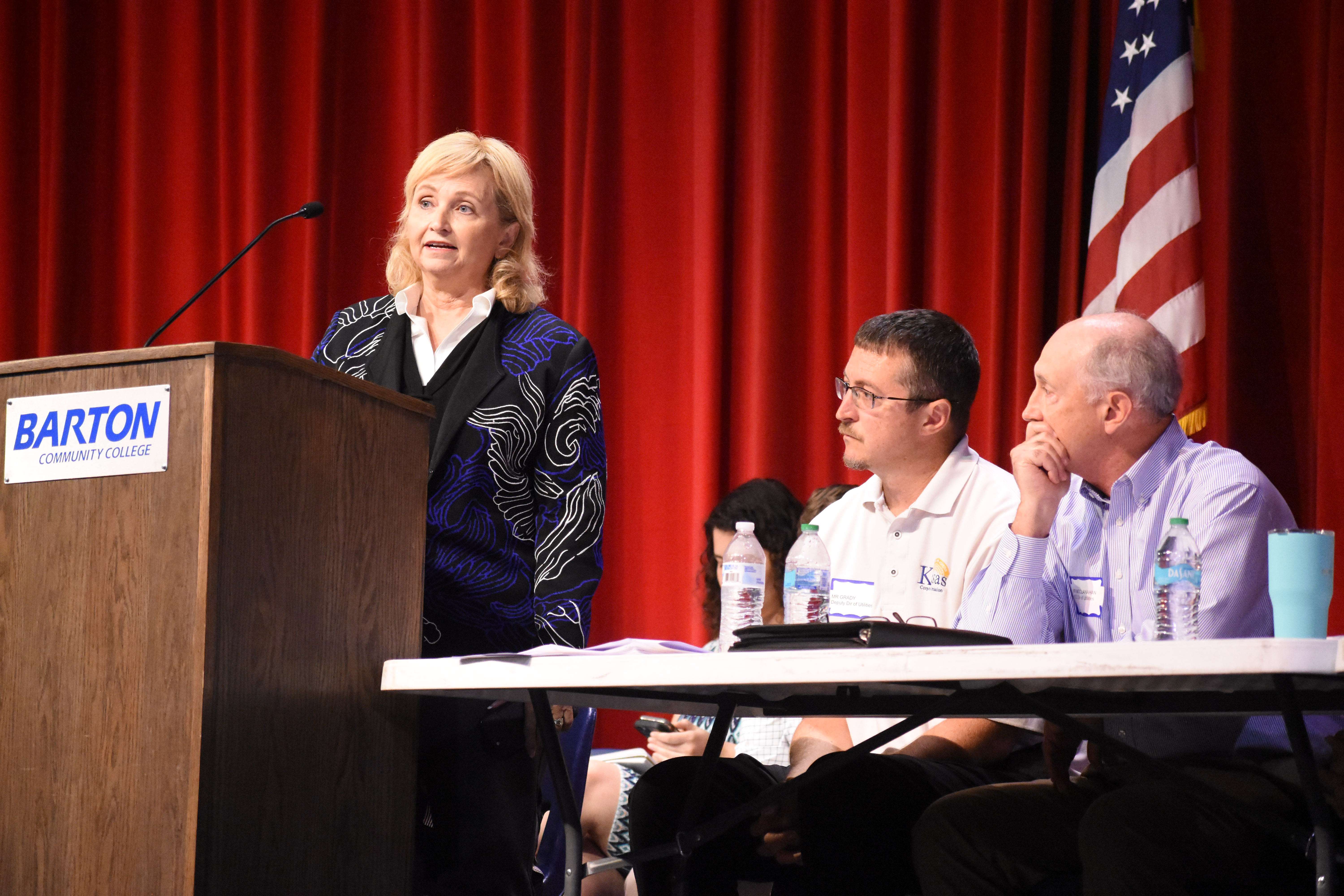
Many questions remain following last Tuesday's tri-county meeting between commissioners from Barton, Pawnee, and Russell Counties at Barton Community College. Several answers were provided beforehand by various entities involved with the Grain Belt Express (GBE) and proposed National Interest Electrical Transmission Corridor (NIETC) that would travel through all three counties. The Kansas Corporation Commission (KCC) has already approved siting of the Grain Belt Express in Kansas. Sen. Caryn Tyson, representing District 12 in the northeast corner of the state, had questions for the KCC during Tuesday's meeting.
"I've sat through several meetings listening to the KCC," she said. "I have one question for you: when are you going to put Kansans first? When are you going to put the people who live in Kansas first? We keep hearing about corporations. We keep hearing about these lines that are transmitting out-of-state energy. We are putting Kansans in harm's way, and we continue to do that, so when are you going to put Kansas first?"
Many comments throughout the evening were directed at the KCC. Jeff McClanahan, director of the utilities division for the organization, said the representatives at Tuesday's meeting are not policymakers.
"We are the technical folks who have a charge to evaluate very complex technical issues and advise policymakers," he said. "That includes our commissioners who make the ultimate decisions, as well as the legislature. That's our role. We take it seriously. We are agnostic, if you will, on the outcome of these issues. We have to follow the statutes and the technical components of what we're evaluating to the best of our ability."
The KCC approved the Grain Belt Express and sited the project in 2013. McClanahan explained after Tuesday's meeting that siting requires the utility constructing the line to hire an engineering firm to determine the route of the project. That study must be filed with the KCC, and statutes require public hearings and due process, after which, KCC commissioners will issue an order on the project. Often, the route is modified throughout the process. McClanahan said the KCC is not directly involved with eminent domain or private companies obtaining easements. During the public hearing process, all affected landowners had the opportunity to weigh in on the matter. The KCC considered any arguments made when finalizing the approved route.
In a written answer provided before Tuesday's meeting, KCC officials said eminent domain proceedings in Kansas require landowners are compensated at fair market value for property easements. KCC's understanding is that GBE offers landowners 110 percent of the fair market value of property easements, plus an additional payment for any tower that is placed on the property.
Even in that agreement, the landowner retains title of the property and can use the land for anything that does not interfere with the ability to operate and maintain the line. The only land taken out of operation is around the towers, which is typically a 40 x 40-foot area of land approximately every 1,000 feet along the line. The answer also said the KCC is unaware of any landowner being displaced by the GBE, nor would it approve a route that required displacement.
KCC's answers provided prior to Tuesday's evening also stated towers associated with the GBE will be 150-170 feet tall. As the GBE path includes an area approximately four miles from the Great Bend Municipal Airport, KCC believes GBE is in discussions with the Federal Aviation Administration about the project.