


By DALE HOGG
Barton County Media Consultant
A small plaque rests on a shelf in Barton County Communications-911 Director Dena Popp’s office. It features a black-and-white rendering of the American flag with one yellow stripe and a simple phrase: “The golden glue that holds it all together,” referring to the oft-overlooked first responders who don’t get the flashing lights and wailing sirens.
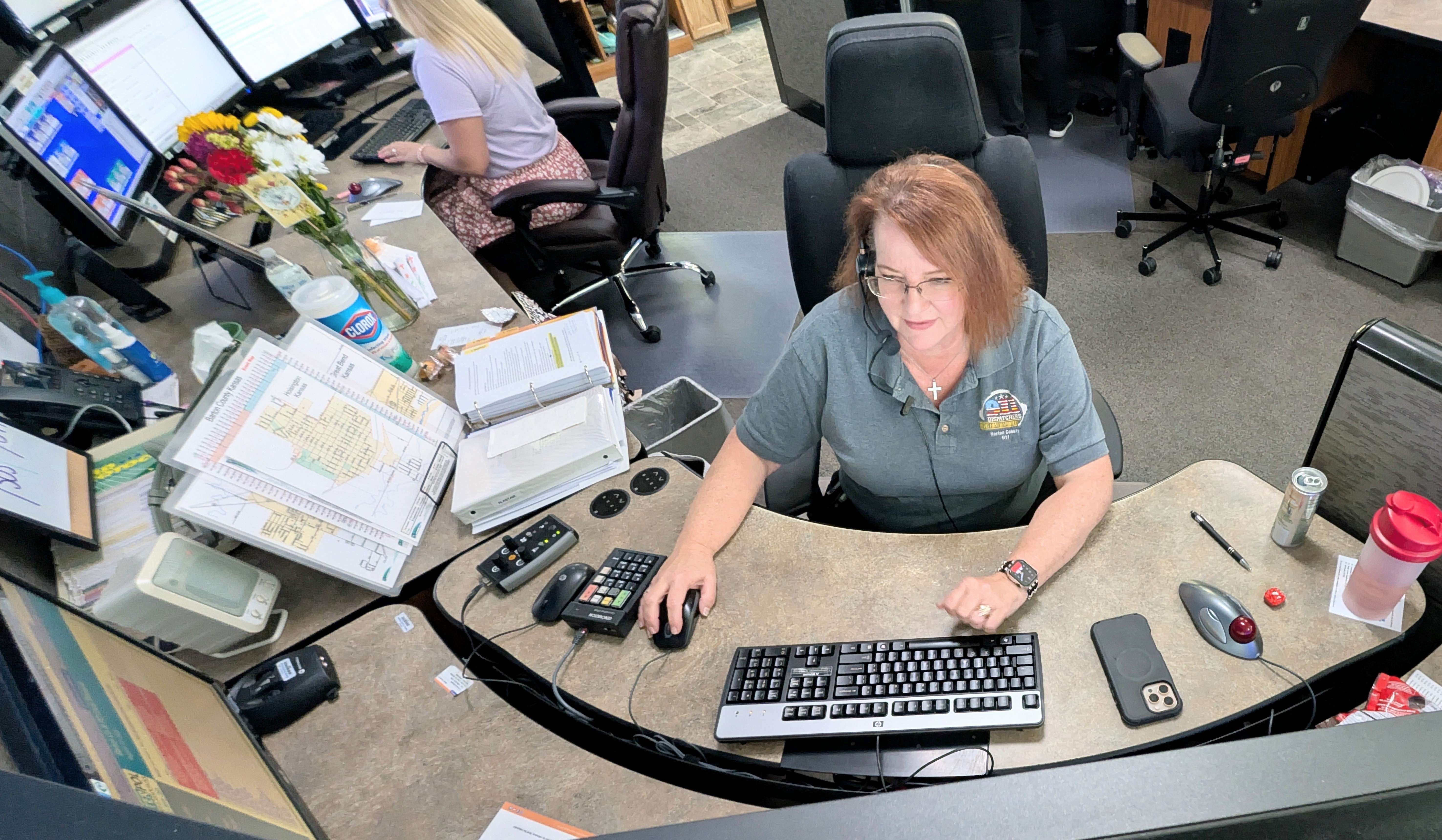
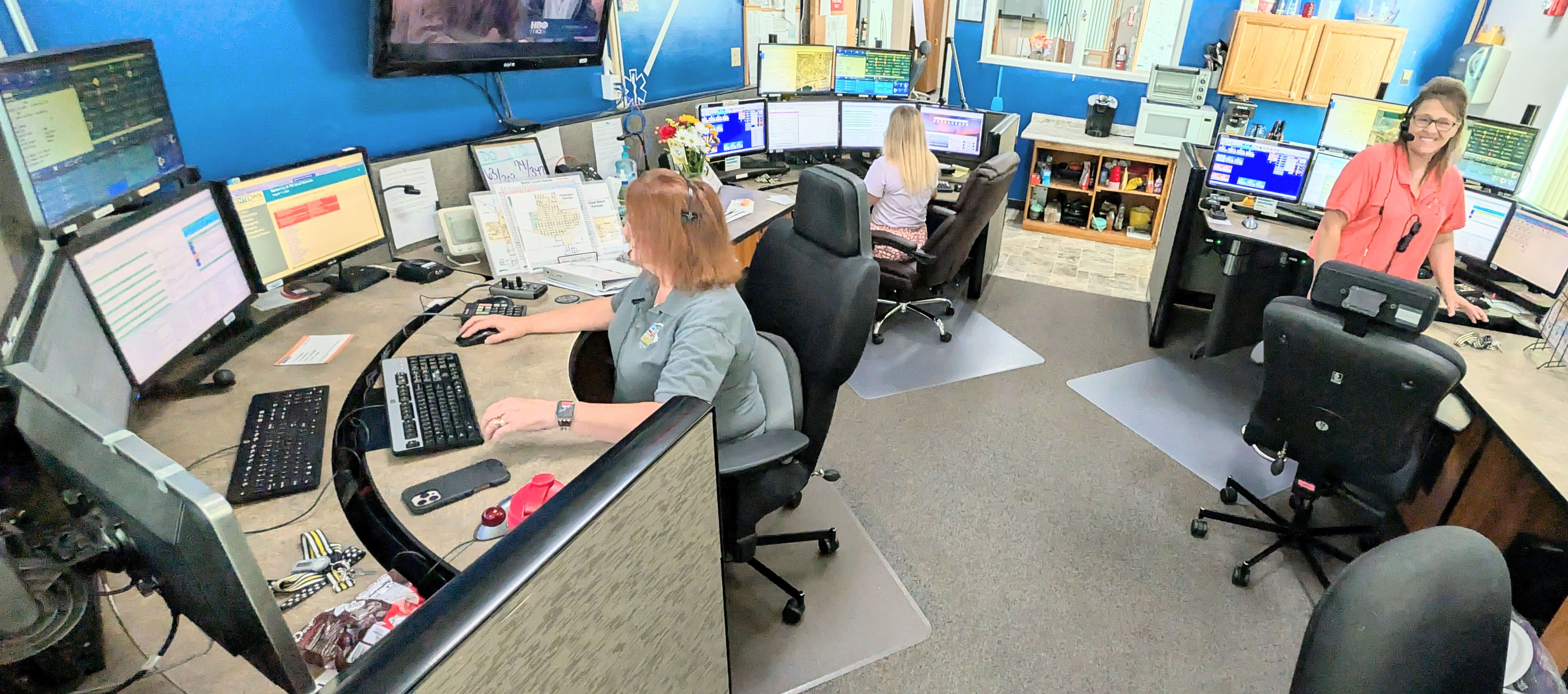
“Oftentimes, the first person a caller is going to come in contact with is a 911 dispatcher,” Popp said. As she spoke, it was a relatively quiet Monday afternoon in the Communications Center but Popp and the two veteran dispatchers on duty knew that could change on a dime.
“There is no such thing as a typical day,” she said. Referring to a recent Friday, she said dispatchers handled 168 emergency and non-emergency calls; however, that number could have easily been much larger or smaller.
“It varies, you just never know,” she said. “It is a guessing game. It can be crazy one moment and you are twiddling your thumbs the next.”
From January through the end of July, dispatch fielded over 21,000 administrative calls and over 7,000 911 calls.
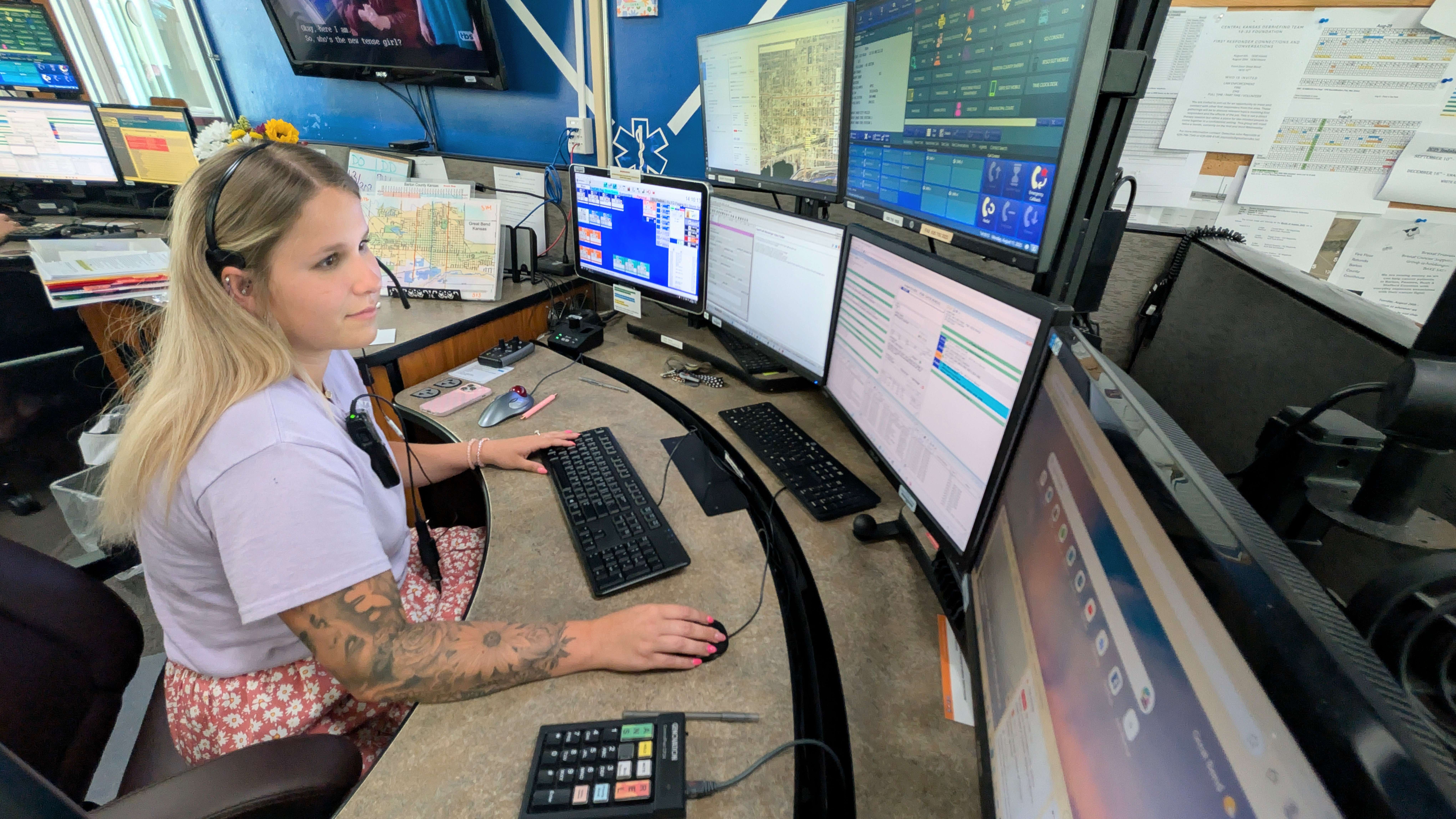
Her office is hampered by being understaffed. There must be at least two people in the call center at all times. Now, with the staff shortage, they are running two-person shifts, but ideally, there would be three on duty.
Full staffing consists of 14 – 13 dispatchers and Popp – but now there are nine. Popp, who started on the call floor, also fills in on the consoles. They do have two in training, but long-time dispatcher Tim McQuade is retiring in September, after over 15 years.
At the 911 center, extensive experience is a common theme. In addition to McQuade's tenure, Popp has worked for the county for 30 years. The dispatch team also brings decades of experience to the job: Melissa Herren has 14 years, Wendy Dougherty has 13 years, John “Drew” Myers has 12 years, Samantha Brown has eight years, and Savannah Kennon has five and a half years.
A true calling
The job is not for the faint of heart, Popp said.
“This kind of shift work, for people with families, can be a challenge,” she said. They work 12-hour shifts, but with the current staff, days can stretch to 14 hours. They do get three or four days off per week, depending on their rotation, but the hours donning the headset can be intense.
“We are the ones who ask the tough questions, the questions people may not want to answer,” she said. The goal is to answer 911 calls in 90 seconds and non-emergency calls in three minutes, so getting pertinent information in a hurry so they can relay it to the responders is vital.
They also must filter the information, and then determine where to send the responders, the correct jurisdiction and what agency should handle the call, all when seconds count.
“When they answer a call, dispatchers are immediately thrust into someone's worst moment,” Popp said. “They speak to people in the throes of a crisis, facing life-threatening situations and other emergencies.”
Dispatchers have to keep their composure while hearing from someone contemplating suicide, a parent dealing with a baby who isn't breathing, or people involved in a fiery car crash. “They're the calm voice on the other end of the line when someone is being threatened with abuse or has just witnessed a violent crime,” she said. “There are calls that stick with you,” Dougherty said. They only hear the panic, sobs and screams on the other end of the line, and their minds can paint a horrific picture of the scene.
Dispatchers must be certified in cardio pulmonary resuscitation and Emergency Medical Dispatch so they can talk callers through the live-saving procedure in crisis situations.
There are, of course, all the good calls. But those aren’t the ones that keep playing in a loop as the dispatchers lie in bed.
These take a toll and focusing on mental health is a vital part of the job, she and all the other dispatchers emphasized. There are resources available, and it is crucial the operators take advantage of them.
“It’s draining,” Dougherty said. “It gets to be a lot. You have to learn not to internalize what you hear, not let the stress build and then not to take it home.”
“I left (the job) twice,” Kennon said, noting she sought help dealing with the stress. “There are certain calls that take a toll on you.”
Still, with the days off, “it is a blessing,” Dougherty said. “You get a lot of time with your family.”
“The sheer volume of calls you get just builds up,” Popp said. “You have to find a healthy way to cope with it.”
Then, there are the accidental, pocket-dialed 911 calls that add to the headaches, even if the caller just hangs up, Popp said. Most of these must be treated as the real thing, occupying the time of the dispatchers who answer them and first responders who must rush to the scenes.
“These are a drain on resources. They just waste so much time,” she said, urging caution. "If the phone can turn on, it can dial 911, whether it has service or not."
Should this happen, she said the caller should just stay on the line and give the operator their name and from where they are calling.
OK, why do it?
So, this begs the question: Why would anyone do this work?
“There is something very important and extremely satisfying in knowing you helped someone in their time of need,” Kennon said. “You have a chance to really make a difference.”
And, there is the other side of the calls.
“There is also a lot of satisfaction in helping to protect your work family,” she said, referring to the firefighters, emergency medical technicians and law enforcement officers on the other end of the radio conversations. “They are relying on the 911 center to provide the information they need to respond safely. The radio is a lifeline for the officers.”
“I love it. I love it. It is an amazing job,” Dougherty. “You get to make a difference. You are the first voice they hear.”
She applied for the opening when she moved to Barton County from Ohio. “I really had no idea what I was applying for or what I was getting into. I just sort of fell into it.”
Apparently, it stuck because she stuck around.
“It runs in my family,” said Kennon. The Great Bend native’s father was a deputy with the Barton County Sheriff’s Office, her mother worked for the Barton County Attorney’s Office, and she has one brother who is an officer with the Great Bend Police Department and another who is a jailer with the BCSO.
“I initially wanted to be a cop,” she said. But a stint as a security guard changed her mind.
“Then I found out that 911 was hiring,” she said. She was hooked.
“Being the backbone for our first responders and someone they can count on inspires me,” she said. “I am honored to be there for our community and make a difference.”
Part of a bigger picture
The 911 Center is the emergency operations center. It handles calls for four EMS departments, 11 fire departments, three police departments, the Sheriff’s Office and the Kansas Highway Patrol.
Barton County 911 works closely with state and national networks to help with its efforts, Popp said. The Kansas Criminal Justice Information System (KCJIS) is a highly secure public safety communication system designed for sharing sensitive criminal justice information.
This system provides agencies with access to critical databases like the National Crime Information Center (NCIC), which contains criminal records for stolen property, missing or wanted persons, domestic violence protection orders, criminal histories, and the National Sex Offender Registry.
Also, all but six counties in the state are on the Kansas Next Generation (NG) 911 phone system. It includes text-to-911, video-911,Teletypewriter and Telecommunications Device for the Deaf (TTY/TDD), and other mapping, redundancy and backup features.
In addition, Barton County has agreements with regional counties to serve as backup should its 911 system go down, Popp said. Barton then reciprocates and is there for the other agencies as well in their time of need.
There are training opportunities and conferences available for continued education and networking. But with the short staffing, Popp can’t afford to send as many to these as she would like.
Popp balances the funding sources, interagency agreements as well as taking turns as a dispatcher. Funding for the department comes from the county’s general fund, the 911 tax (collected by phone service providers and then divvied up to counties) and other state funding sources.
National Public Safety Telecommunicators Week, also known as 911 Dispatcher Appreciation Week, is celebrated annually during the second week of April. This week is dedicated to honoring the dedication and service of public safety telecommunicators, who are the first point of contact in emergencies.