


By DALE HOGG
Barton County Media Consultant
Stopping short of a ban on large commercial-sized wind energy developments, the Barton County Commission Tuesday morning approved a series of resolutions that enacted major updates to the county’s zoning regulations for wind energy projects.
Balancing the preservation of the rights of landowners and keeping commercial-scale wind turbines from infringing on the county’s “way of life,” the commission adopted three separate resolutions upholding the 79-page recommendations put forth by the Barton County Planning Commission following a year of meetings, review and study sessions.
The resolutions primarily addressed three categories of WECS: Small-Scale Single-Use, Large-Scale Non-Commercial, and Commercial-Scale. Environmental Manager Judy Goreham presented the amendments, which will be incorporated into the Barton County Zoning Regulations, Version II, originally adopted in 2013.
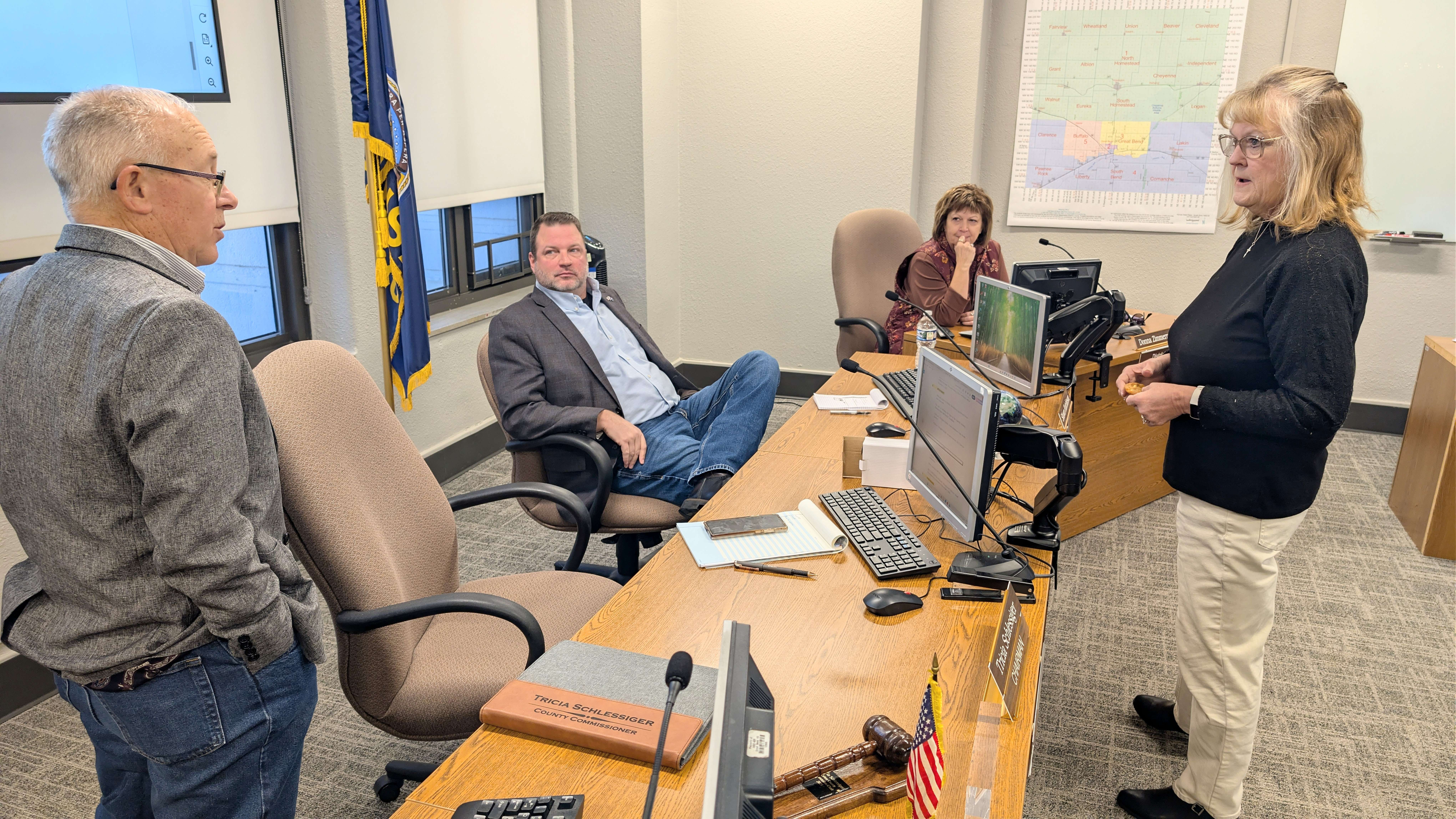
Commissioners had no issues with the non-commercial systems, but it was Commissioner Shawn Hutchinson who suggested the commercial projects (with towers 800-feet tall or more) be banned.
“If we want to ban them, it is on us,” he said. “The Planning Commission did its work.”
It was noted that the new requirements for the commercial turbines were so restrictive that they were, in effect, a ban. Hutchinson said implementing a ban was the Planning Commission’s intent and an outright ban would make enforcement easier.
But, while Commissioner Barb Esfeld understood Hutchinson’s point, “I like the way (the Planning Commission members) have written them. You guys have done a good job protecting the county.”
Esfeld and Chairperson Tricia Schlessiger also felt a ban, although well-intentioned, was infringing on the rights of property owners. It also put restrictions on farmers who work in an already heavily-regulated industry.
According to state statute, approval of the changes as presented would require a simple majority of the Commission. However, if commissioners wanted changes or to send the regulations back to the Planning Commission for a rewrite, a two-thirds majority (or at least a 4-1 vote) would be needed.
Hutchinson’s motion for a ban failed on a 3-2 vote. He and Commissioner Donna Zimmerman and Duane Reif voted for it, and Commissioners Schlessiger and Esfeld voted against it.
In addition, with the Cheyenne Bottoms Wildlife Area playing such a big role in restricting wind project development, the wetlands prevent many projects from even being considered in Barton County.
It was also said that during the Planning Commission’s public hearing on the guidelines, no one was present to offer any opposition.
The winds of change
“I am actually very happy to be here in front of you today with this request,” Goreham said. “About a year and a half ago, our Planning Commission started work on completely rewriting the wind energy regulations that were originally adopted for single-use use small-scale only in Barton County back in 2007.”
“When we decided to attack this project, we took the template we had used for solar that we adopted in March of 2024, and we tried to create a very similar structure of regulations, but as we reviewed each thing, we consider the difference between a solar panel and a wind turbine,” she said.
Zoning districts updated for WECS
Resolution 2025-18 amended Article III of the zoning regulations, specifying where each WECS type would be allowed within the county's seven zoning districts:
· Small-scale single-use WECS were designated as permitted in the Agricultural and Industrial Districts, and Conditionally Permitted in all five other districts. This would be a single turbine not connected to the power grid.
· Large non-commercial WECS were established as Conditionally Permitted in all seven zoning districts. These involve more than one turbine on a property not connected to the grid.
· Commercial-scale WECS were set as Conditionally Permitted in the Agricultural, Commercial, Industrial, and LMSC (Limited Manufacturing/Service Commercial) Districts, but Not Permitted in the Residential District, Unincorporated Community District, and Planned Community District. These are the massive towers that can stand 800 feet or more.
Setbacks and safety rules detailed
Resolution 2025-19 amended Article VIII to detail specific regulations and requirements for the three WECS classifications, focusing heavily on setbacks and environmental safety measures.
The new regulations provided clear definitions and restrictions:
· Small-scale single-use WECS (150 kW or less, 120 feet or less in height, for a single, particular use) must have a setback of no less than 1.1 times its total height to the nearest property line.
· Large non-commercial WECS (business or cooperative use, 150 kW or less, 120 feet or less in height, or where more than one turbine is proposed) required a setback of six times the total height to the property line. With a waiver, the minimum setback to a structure would remain 1 1/2 times the height of the turbine.
· Commercial Scale WECS (greater than 150 kW, or greater than 120 feet in height, connected to a larger electrical network) established a significant setback of one mile to a non-participating landowner's property line or 10 times the height, whichever is greater.
The planning commission opted to protect all structures in setback requirements, declining a suggestion from the County Commission to only include "residential" structures when considering variances.
Commercial-scale WECS were also mandated to employ specific technology to mitigate wildlife impact to prevent unnecessary bird and bat fatalities. No shadow flicker would be permitted beyond the property line for non-commercial and commercial systems.
Goreham said should any such project be proposed, she would be in contact with all state agencies and wildlife organizations to get their
Goreham said should any such project be proposed, she would be in contact with all state agencies and wildlife organizations to get their input.
Zoning map divided for clarity
To clarify the complex layers of new regulations, Resolution 2025-20 officially replaced the single Official Barton County Zoning Map with three separate maps: a General Zoning Map, a Solar Energy Conversion System (SECS) Map, and a new Wind Zoning Map.
The new Wind Zoning Map reflects an expanded No-Build Zone for Commercial Scale WECS, creating an area one mile outside of the previously adopted no-build zone for SECS around the Cheyenne Bottoms area. The No-Build Zone and the additional Conditionally Permitted Zone for all Small Scale Single Use wind energy around the Bottoms, originally adopted in 2007, was retained.