


By MIKE COURSON
Great Bend Post
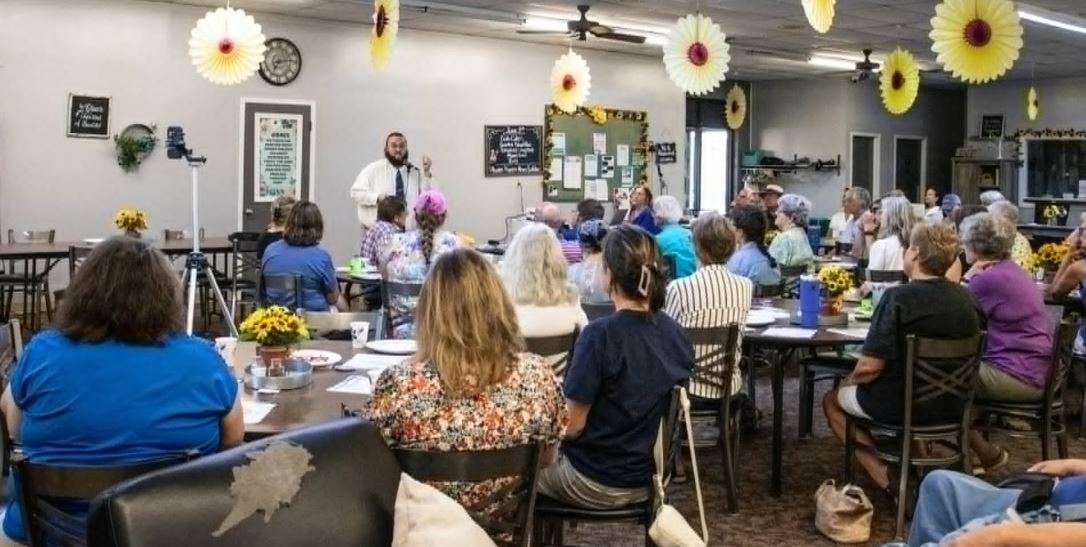
Advocates of an upcoming ballot amendment in the Aug. 4 primary election say the change will give more power to the voters when it comes to selecting Kansas Supreme Court justices. Opponents say not so fast: the current system was created to keep money and special interests out of the judiciary, and the system has worked since being approved by voters in 1958. Last week, Judge Karen Arnold-Berger and Logan Stenseng with Kansas Appleseed provided information about the proposal during an event at the Great Bend Senior Center, hosted by Women for Kansas Barton County.
“The idea was your legislative and your executive branch are elected by the people,” Arnold-Berger said. “They are there to represent the views of their constituents. But not the judicial branch. The judicial branch is there to base their decision on the facts and the law of the case, and not be swayed by public opinion or political pressure. That is exactly why it was set up that way.”
Kansas entered the union in 1861. The infamous “Triple Play” scandal took place several decades later when Gov. Fred Hall lost a primary election to another Republican. Democrat George Docking was elected governor in the 1956 general election. With just 11 days left in his tenure as governor, Hall resigned in January 1957, allowing Lt. Gov. John McCuish to appoint him to a vacancy on the Supreme Court before Docking took office.
The people of Kansas responded. In 1958, voters approved an amendment for a merit-based system to appoint Supreme Court justices with 60 percent of the vote.
“In 1958, when our parents and grandparents voted on this, they weren’t duped into something,” Arnold-Berger said. “They knew exactly what was going on. All of the same arguments that are going on today were made to them.”
The amendment created a 9-person Supreme Court Nomination Commission comprised of four non-attorneys and four attorneys from each of the state’s congressional districts. Attorneys are elected by attorneys in those congressional districts, not the Kansas Bar Association. The ninth member, the chairman, is an attorney elected by lawyers statewide.
Anyone can apply to be a Supreme Court justice. They must undergo an extensive professional and personal background check. They are interviewed by a non-attorney and attorney, and those interviews are available to the public. The top three candidates are forwarded to the governor for selection to the Supreme Court.
“The idea is, we’re going to send three names to the governor, and he or she can’t go wrong,” said Arnold-Berger. “All three of them are going to be good, high-quality candidates. That’s the idea.”
Arnold-Berger and Stenseng pointed out flaws with the current ballot amendment, including the choice to include the matter on a primary ballot when voter turnout is typically low, and the fallacy that Kansas voters have no say on Supreme Court justices. Stenseng highlighted the 2022 election in which Kansas Attorney General Kris Kobach received more than 506,000 votes, or nearly 51 percent, to win the election. In that same election, between 574,000 and 639,000 Kansas voters chose to retain the seven Supreme Court justices in seven separate votes.
“So our question was, why does the will of voters, when they vote, only count when they vote for you and not when they vote to keep their justices?” Stenseng said. “He had no answer to that. It’s because Kansans have made up their mind.”
Arnold-Berger cited how partisan elections can impact judicial selection. In 2025, $51 million was spent per judicial candidate during a Wisconsin race. Approximately 45 percent of that money flowed in from out-of-state. In 2023, $23 million was spent per judicial candidate in Pennsylvania. In 2001, out of 2,500 judges polled nationwide, only 36 believed campaign contributions had no impact on the judicial process.
Stenseng reminded last week’s crowd that Kansas voters do get to vote to retain justices or not every six years, and highlighted the fact that disallowing judicial candidates from receiving campaign contributions is not included in the ballot amendment as presented. He also said the current system allows for more rural representation in the Supreme Court, citing sitting judges from Caldwell and Goodland.
Arnold-Berger said opponents for the amendment claim the Kansas Supreme Court is often overturned at the national level. Since 1966, the national average of reversals is 77 percent, compared to just 66 percent for the Kansas Supreme Court.
Opponents fear the proposed amendment will impact the state’s policy on large issues, including abortion and education funding. In 2022, 59 percent of Kansas voters decided against a constitutional amendment that would have declared that the Kansas Constitution does not guarantee a right to abortion. Republican lawmakers have since tried to sidestep that vote. The Kansas Supreme Court has also routinely forced the legislature to fund public schools and special education.