



written by: Stacy Campbell - Cottonwood Extension District
The precipitation we have been receiving is great for our spring planted crops but it has also helped weeds to flourish as well.
Due to a fast growth habit, Palmer amaranth seedlings can grow up to a half-inch in height per day under current Kansas weather conditions and can easily escape the recommended plant height (3- to 4-inch) for herbicide applications in wheat stubble. As glyphosate-resistant Palmer amaranth is also quite common in Kansas wheat fields, controlling those large-sized glyphosate-resistant Palmer amaranth populations in wheat stubble can be a daunting task.
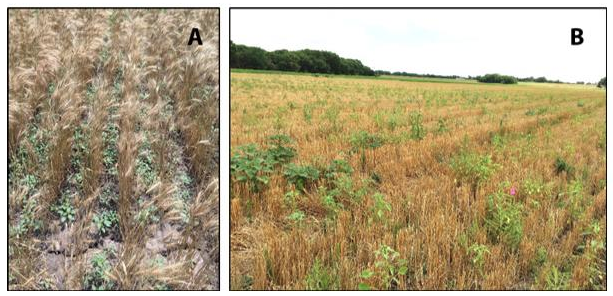
Figure 1. (A) Emerged Palmer amaranth seedlings under poor wheat canopy, and (B) Palmer amaranth growth in post-harvest wheat stubble at the time of herbicide applications in 2019. Photos by Vipan Kumar, K-State Research and Extension.
A field study conducted in 2019 at the K-State Ag Research Center near Hays, KS evaluated various herbicide programs, including Roundup PowerMax, Clarity, 2,4-D, Aatrex, Gramoxone, Sencor, Valor SX, Spartan, Sharpen, Authority Supreme, Kochiavore, Panther MTZ, and Huskie applied alone or in tank-mixtures (24 total programs) for Palmer amaranth control in post-harvest wheat stubble (Table 1). The experimental site had a natural seedbank of Palmer amaranth population (sensitive to glyphosate). Palmer amaranth plants were treated when reached to the height of 2 to 2.5 feet and were showing signs of inflorescence initiation or flowering (Figure 1B).
Table 1. List of herbicide programs tested for controlling Palmer amaranth in post-harvest wheat stubble at the Kansas State University Agricultural Research Center near Hays in 2019.
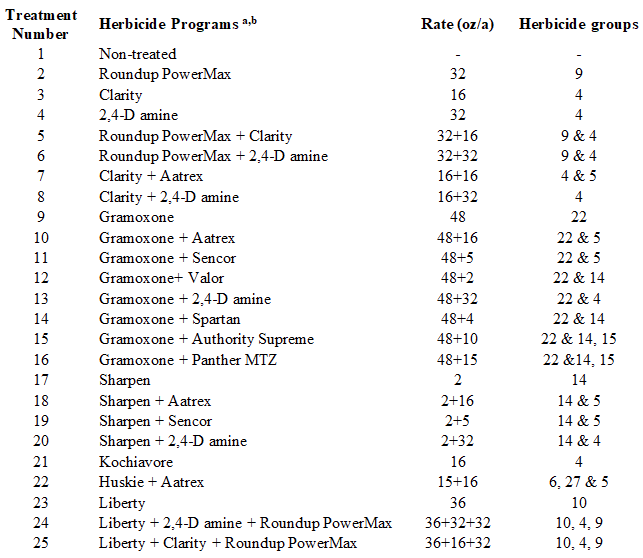
- Herbicide treatments were applied on 2- to 2.5-ft tall Palmer amaranth plants showing inflorescence initiation in post-harvest wheat stubble.
- All treatments were applied with appropriate adjuvants as dictated by each herbicide label.
Results indicated that all tested herbicide treatments provided excellent late-season control of Palmer amaranth (>88% control) at 8 weeks after treatments (WAT), except Kochiavore and a tank-mixture of Huskie + Aatrex (Figure 2). A majority of the tested programs significantly reduced Palmer amaranth seed production (>93% reduction) compared to the non-treated weedy check (data not shown). The least Palmer amaranth control was observed with Kochiavore and a tank mixture of Huskie + Aatrex in comparison to the non-treated weedy check (Figure 2). Tank-mixtures containing soil-residual herbicides such as Aatrex, Sencor, Valor, Spartan, Authority Supreme, and Panther MTZ also prevented any late-season flush of Palmer amaranth.

Figure 2. Effect of late-season herbicide programs on Palmer amaranth control at 2, 4, and 8 weeks after treatment (WAT) in post-harvest wheat stubble (see table 1 for herbicide treatment number).
Important note: Growers are advised to read each herbicide label for rotational crop restrictions (for next summer crop) before using any of these mentioned products.
Brand names appearing in this publication are for product identification purposes only. No endorsement is intended, nor is criticism implied of similar products not mentioned. Persons using such products assume responsibility for their use in accordance with current label directions of the manufacturer.
Information and research study was conducted by Vipan Kumar and Rui Liu, Weed Management Specialists, Agricultural Research Center – Hays.