


From the Chamber
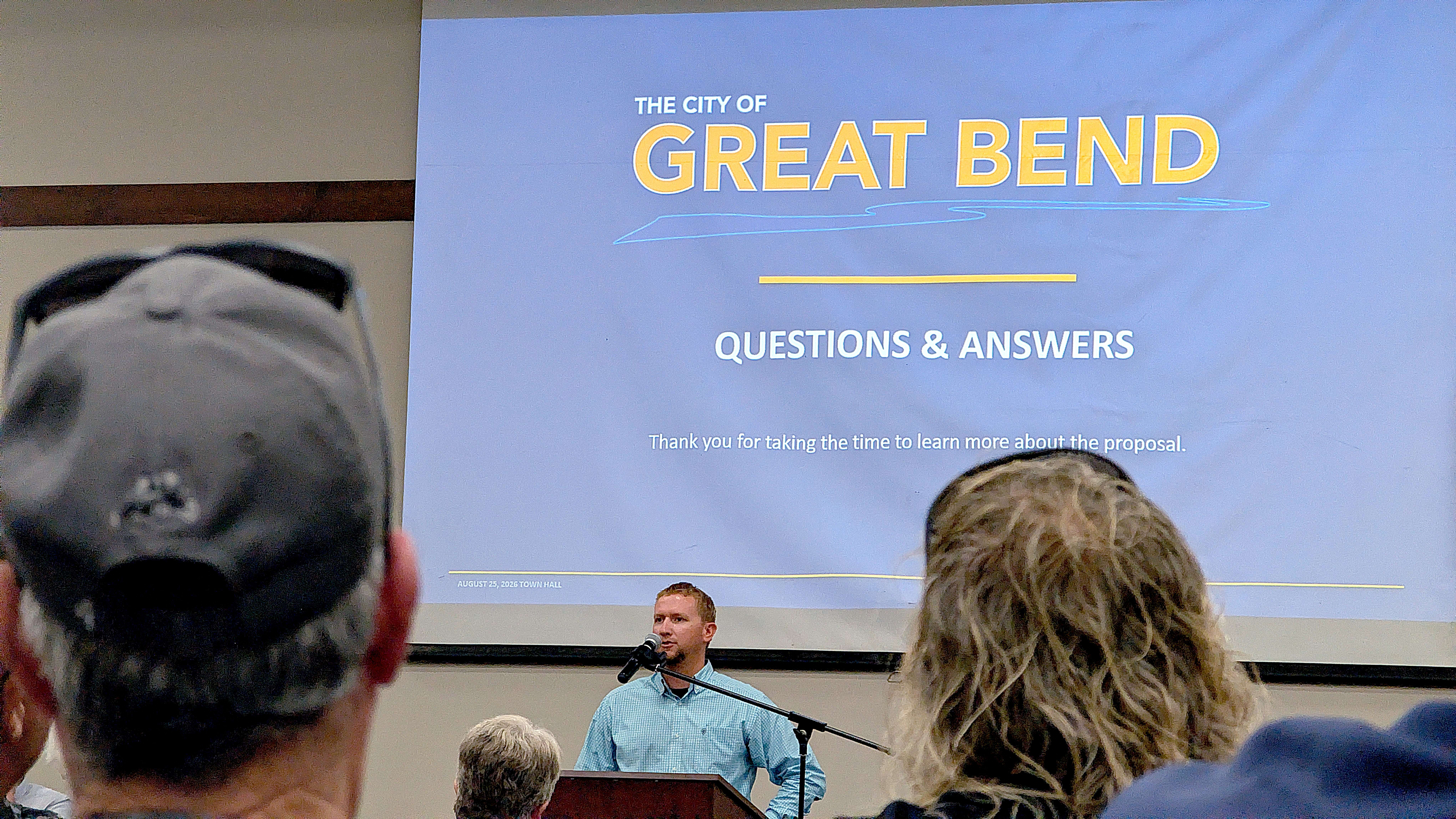
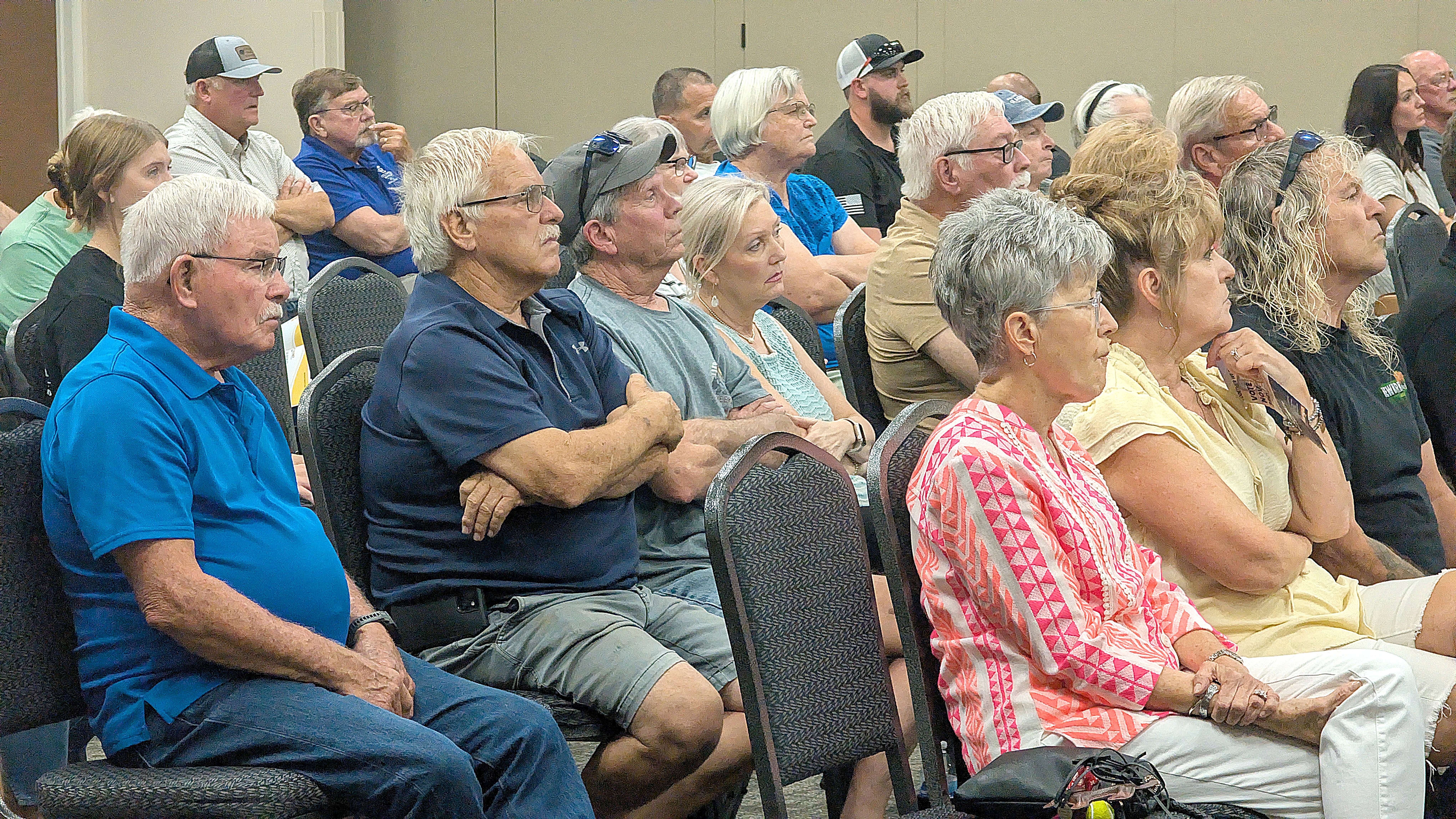
An inquisitive crowd settled into the Great Bend Events Center Tuesday night as city officials fielded questions on the proposed three-quarter-cent sales tax as they made their case for the levy’s importance to the community’s future.
The event was the first of two townhall-style meetings aimed at explaining the plan intended to pay for upgrading the water treatment facility, the city’s portion of the STAR Bond economic development project and help lower the property tax burden for residents. The second meeting is set for Oct. 6 at the Events Center, 3111 10th St.
The interest Tuesday was a good thing, said Megan Barfield, Great Bend Chamber of Commerce president and chief executive officer.
“It’s fantastic to see the people participating and getting involved,” she said before the meeting started. While remaining neutral, the chamber grasps the potential impact of the tax and just as excited to see so much engagement.
“Regardless of one’s thoughts on the city’s plan, the only way they can make their opinions count is to vote,” she said. She reminded folks the voter registration deadline is the end of the business day on Tuesday, Oct. 13.
There were concerns about the increase in taxation, and questions about the condition of the treatment plant and about the need for the expansion of the dragstrip sports complex. But, there were also those who indicated they’d whole-heartedly support the measure.
What is the city asking for?
The Great Bend City Council passed a resolution Monday, Aug. 17, meeting to place a proposed three-quarter-cent sales tax measure on the Nov. 3, 2026, general election ballot, aiming to fund critical infrastructure and provide local property tax relief.
If approved by voters, the initiative would raise the city’s sales tax rate from 8.7% to 9.45% starting April 1, 2027. Officials estimate the increase would generate approximately $3.6 million annually and note the total would be comparable to surrounding similarly sized communities.
City Administrator Logan Burns said the proposed tax is designed to distribute the financial burden of major municipal improvements across both residents and visitors.
Unlike temporary measures, the proposed three-quarter-cent sales tax will have no sunset date.
"Sales tax is a shared funding source paid by everyone who shops, not just residents," Burns said, noting that Great Bend serves as a regional retail hub. "Among the available options to address emergent city needs, a three-quarter-cent sales tax is the most cost-effective solution for Great Bend residents."
City officials estimate that Great Bend sees around 4 million visitors annually, many of whom spend money here. The more traffic and the more money generated by an expanded Expo Complex mean more funds will be available for the plant and other projects, Burns said.
He said the tax amounts to an additional 75 cents on a $100 purchase, or $7.50 on a $1,000 buy.
The resolution structures the proposed tax into two primary allocations:
· Infrastructure (½ cent): Half a cent will be dedicated to infrastructure. One-quarter cent is earmarked for necessary upgrades to the city's wastewater treatment plant. The city has secured approval for a 30-year low-interest loan through the Kansas State Revolving Fund for the project.
The water treatment plant
The wastewater treatment facility provides an essential service that serves every resident and business. It is a secondary treatment facility that runs 24 hours a day, 365 days a year and processes approximately 1.2 million gallons of water daily, allowing recycled wastewater to be cleaned and safely returned into the Arkansas River.
Officials started studying the plant and its needs last year. Several City Council meetings and work sessions with engineers led to realization there were serious issues that couldn’t be addressed within in the current city funding structure.
Built in 1954 and last substantially upgraded in 1997, the facility is operating well beyond its intended lifespan as components in a wastewater facility average 20-25 years with many of the current assets exceeding that timeframe, Burns noted, adding they don’t have the option to shut it down.
“Worst case scenario, you don’t flush your toilets tomorrow,” Burns said.
Although city staff have extended the life of the system, many components are nearing the end of their useful life and require replacement to continue safe treatment practices. And, they have to keep pace with changing Environmental Protection Agency and Kansas Department of Health and Environment regulations.
The estimated cost of the necessary wastewater treatment facility improvements is $26.3 million and will be completed regardless of the outcome of the sales tax proposal, according the city.
The project also includes the GIS (geographic information system) mapping of the city’s 100 miles of water service lines and 90 miles of sewer lines. This computer map will provide accurate locations for these lines, which is not currently available citywide.
Without the proposed sales tax, project costs would need to be funded primarily through utility rate increases beginning in 2027, resulting in an estimated annual increase of $240 to $300 per customer, or about $20 per month for each of the city’s 6,600 water meters.
The STAR Bond effort
The remaining quarter-cent of the infrastructure allocation will support the city’s general obligation for a proposed STAR Bond project aimed at expanding the Expo Complex into a regional tourism hub, which carries an estimated annual debt service of $1.3 million.
STAR (Sales Tax and Revenue) Bonds are an economic development financing tool in Kansas that allows municipalities to issue special bonds to fund major commercial, entertainment and tourism projects. The borrowed money is paid back using the future state and local sales tax revenue generated within the designated STAR bond district.
The City has the approved up to $21.89 million from the state in STAR Bond financing to expand the Expo Complex with new attractions and upgrades. The project would be implemented in two phases and cost a total of $56.1 million, with the city owing 16% ($8.9 million) of the total.
According to information from the city, this sales tax is needed to pay off the city's debt on the project. If the sales tax does not pass, this project will likely not happen.
The Expo Complex growth includes major expansion of the historic Sunflower Rod and Custom Association (SRCA) Drag Strip, including three new structures, grandstands, and a spectator crossover bridge. Development of a multi-purpose event center (42,000 square feet, 5,000 fixed seats), a 12,000 square foot banquet hall, and possible trampoline park are also included in the project.
In future projected phases of the project, the creation of an outdoor amphitheater with capacity for 3,500 to 4,000 guests, a new airport hangar, and restaurant amenities would be added in addition to the construction of an indoor livestock arena with 2,527 permanent seats and an adjacent outdoor rodeo arena seating 2,500 to 2,700.
Burns noted the council has the flexibility to pick and choose which of these initiatives gets funded first or funded at all, depending on the city’s other pressing needs.
The STAR Bond consists of two districts, the Expo Complex area and the development of the new Hampton Inn hotel and adjoining eating establishments on 10th Street. The $22 million cost for these is was included in the city’s application to leverage more state funding, but is being footed by the developers.
The STAR Bond project is financed through two funding sources: STAR Bonds and City General Obligation (GO) bonds. STAR Bonds are repaid from the incremental sales tax generated within the STAR Bond district and are expected to finance a significant portion of the eligible project costs. Any eligible costs not covered by STAR Bond proceeds would be financed through city GO bonds which come with a higher interest rate.
The proposed sales tax is intended to provide a dedicated revenue source to repay the city's estimated GO bond obligation. While the City could legally issue temporary notes or GO bonds without the sales tax, doing so would significantly increase the city's financial risk because repayment would have to come from existing revenues or future property taxes.
Burns said the sales tax serves as the City's financial safety net by providing a predictable repayment source for the GO bonds, reducing reliance on property taxes and allowing the project to move forward in a fiscally responsible manner.
Without approval of the sales tax, the City Council would need to carefully evaluate whether to proceed with the project, as the City's GO bond obligation would no longer have a dedicated repayment source and could place significant pressure on future budgets and the property tax levy, he said.
Once fully completed and operational, the STAR Bond is expected to support 400 permanent jobs and attracted between 380,000 - 470,000 annual visitors according to a State of Kansas feasibility study.
The STAR Bond Project would be funded through a combination of STAR Bond financing, the sales tax proposal, private investments, and the city’s general obligation bond. The city would issue approximately $30 million in temporary notes to fund the project and make interest-only payments for four years before the project begins generating revenue. The city’s required general obligation bond is estimated at $16.9 million.
Based on estimated project revenues, the city’s general obligation payment is expected to be reduced to $1.3 million which would be funded through ¼ cent of the ¾ cent sales tax proposal.
STAR Bonds are repaid through incremental state sales and city sales tax generated within the districts (the Expo Complex and hotel location), along with Community Improvement District (CID) revenues and transient guest tax.
STAR Bonds are not repaid with property taxes and the city has no obligation to cover any short falls or defaults associated with the STAR Bond repayment.
· Property Tax Relief (¼ cent): One-quarter cent will be dedicated directly to property tax relief to help minimize future increases to the city's mill levy, according to information from the city. This is anticipated to raise about $1.3 million annually, the equivalent of over eight mills.
One mill is equal to $1 in taxation for every $1,000 in valuation (essentially the total value of all the property in the county). For 2026, the price of one mill is $144,666.
If the STAR Bond project generates sufficient revenue to cover its operations and debt service, any unused portion of the dedicated quarter-cent tax will be redirected toward water infrastructure priorities.
Those future projects include improvements to water wells, distribution systems, blending infrastructure, and the construction of a reverse osmosis treatment plant to improve municipal water quality.
Furthermore, once primary obligations are fulfilled, remaining revenues will address deferred maintenance across public lands, utilities, and public works.
What are the alternatives?
"Failure to pass the three-quarter-cent sales tax will result in significantly higher utility bills by nearly $240 to $300 annually for wastewater treatment facility upgrades," Burns said. "The potential money from the state STAR Bonds program would go to another community, the project will not come to fruition, and the chances of raising property tax are increased."
Addressing alternative funding methods, Burns explained that while city officials actively pursue state and federal grants, competitive grant programs cannot be relied upon as guaranteed funding for multi-million-dollar capital projects.
"City officials constantly seek grant opportunities in a highly competitive market, but those opportunities are not guaranteed when planning out essential and costly town projects," Burns said. "A secure form of revenue from a sales tax guarantees the city can afford to conduct needed improvements without raising property taxes or utility bills."
The city's finance department has maintained strong financial oversight leading up to the resolution, Burns said. At the June 1, 2026, council meeting, Sean Gordon of Gordon CPA presented the city’s 2025 audit report, which received an unmodified "clean" opinion—the highest rating available for municipal financial management.
About the Great Bend Chamber of Commerce
The Great Bend Chamber of Commerce serves as the leading visionary advocate and voice for the local business community, dedicated to enhancing the economic climate of the Great Bend area. Through a strategic focus on business advocacy, community marketing, and future-forward investment, the Chamber fosters an environment where existing members can reach their goals while new enterprises are welcomed and empowered to grow. By delivering high-value services and cultivating vital partnerships, the Great Bend Chamber remains committed to providing its members with the best possible impact for their investment and ensuring a thriving, connected marketplace for all. Visit greatbend.org.