


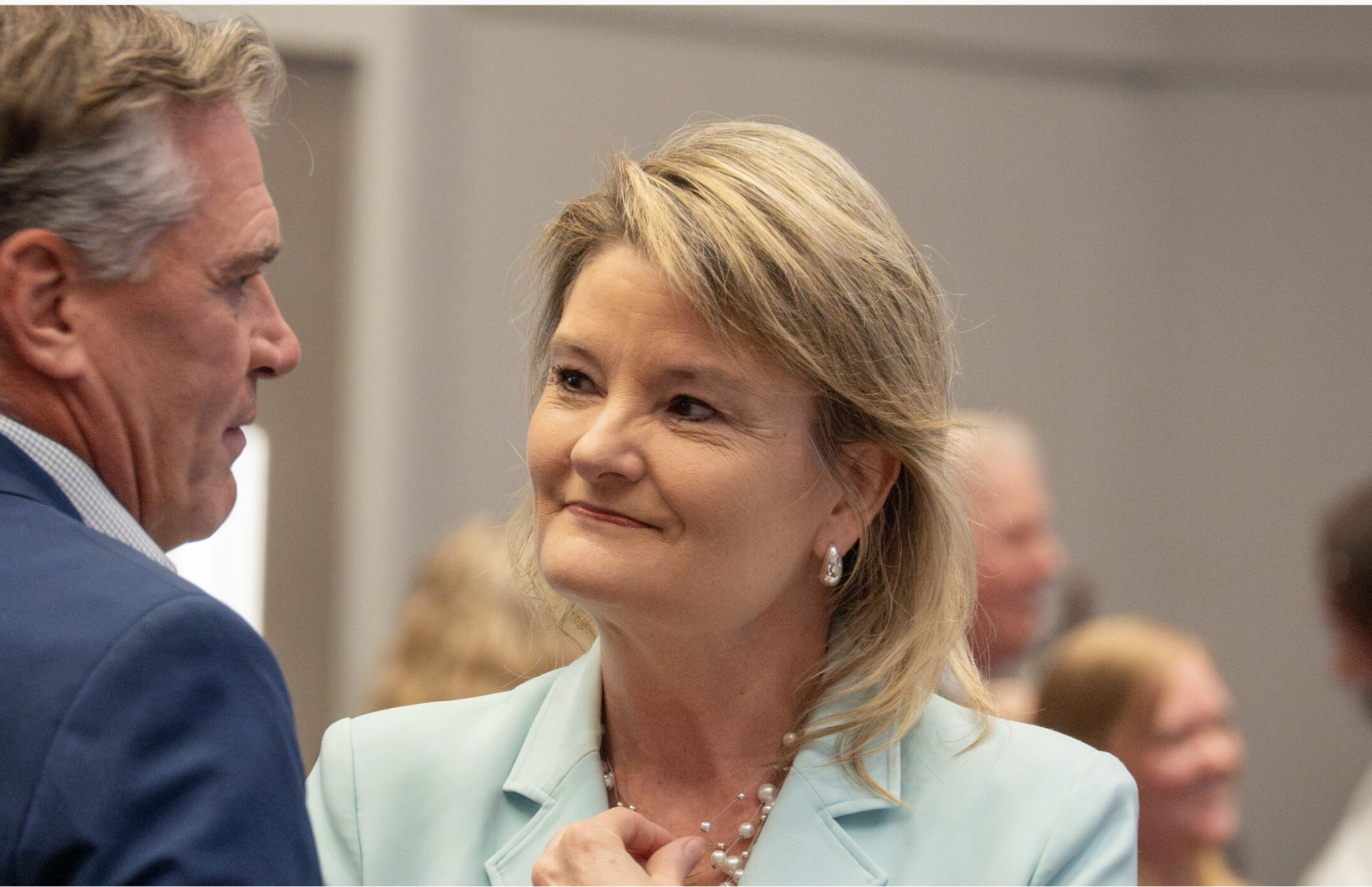
Overland Park senator touts record on public schools, healthcare, marijuana legalization
By: Tim Carpenter
Kansas Reflector
TOPEKA — Democratic gubernatorial candidate Cindy Holscher closed out a campaign interview by accepting the hypothetical challenge of trying to persuade a group of undecided Kansans to vote for her.
Holscher, who is challenging Republican nominee Ty Masterson on Nov. 3, slipped into campaign mode to emphasize her accomplishments as a member of the Legislature and the value of a governor working collaboratively at the Statehouse. She said the next governor must deliver for regular Kansans struggling to make ends and not kowtow to corporate elites or special-interest lobbyists.
“I have an ability to get things done,” she said on Kansas Reflector’s podcast. “I’m going to find people who will work with me, but I’m also going to draw the line on things that … aren’t good for Kansans. I’m the most successful Democrat in the Senate in terms of getting bills implemented, but I’m also more successful than 90% of the Republicans. My focus is on the people and making life better for them through impactful legislation and actions.”
Holscher, 57, is a member of the Kansas Senate and won a tough gubernatorial primary. She said that’s where similarities to Masterson ended.
Holscher resides in Overland Park, while he lives in Andover. She has touted abortion rights and Medicaid expansion. She argued for full funding of special education in K-12 public schools. She endorsed the idea of legalizing marijuana. Masterson rejected those positions.
The Democrat blamed President Donald Trump for driving up the cost of living with ill-advised tariffs and war. In the GOP’s August primary, Trump’s endorsement put Masterson over the top.
She helped build a coalition of legislators who voted to repeal Republican Gov. Sam Brownback’s 2012 law slashing state income taxes. Brownback’s tax policy cratered the state budget and prompted a sales tax increase, heavy borrowing and cuts to core services. In 2017, Masterson condemned the bipartisan bill — supported by Holscher — that ended the Brownback economic development strategy. Masterson has served as Senate president since 2021.
“The absolute concern here is that, as my opponent has said before, he feels the Brownback experiment didn’t go far enough,” Holscher said. “He wants to take over this state and, should he become governor, we will see something worse than the Brownback experiment. I tell people, you know, that’s a warning to us in terms of where he is and what he wants to do to Kansas.”
“He has been very hostile to public education, trying to defund our public schools. He has attacked voting rights. He keeps talking about property taxes, yet he’s been in charge for six years, has a supermajority … but hasn’t answered and hasn’t solved these issues of property tax,” she said.
Missouri farm roots
Holscher was born in Missouri, graduated from Slater High School and earned a degree at the University of Missouri. She was the granddaughter of tenant farmers. Her father served in the Marine Corps and held a union job. Her mother worked at a public school.
“A good union job and public education, those were the things that propelled my family upward out of poverty,” she said.
She has been married for more than 30 years to Greg Holscher, an engineer. She previously worked for Sprint. They settled in Kansas and sent their three children to Johnson County public schools.
“We’re very proud of the education our kids received. We have a lot of teachers out there that just pour themselves into our kids,” Holscher said.
In 2016, Holscher defeated Republican incumbent Rep. Amanda Grosserode to take a seat in the Kansas House. She served two terms before being elected to the Kansas Senate in 2020. She was reelected in 2024. In August, Holscher defeated state Sen. Ethan Corson and Overland Park Mayor Mayor Curt Skoog in the Democratic gubernatorial primary, despite Gov. Laura Kelly’s endorsement of Corson. Holscher defeated Corson by a margin of 48.7% to 38.6%, with Skoog trailing at 12.6%. The Democratic governor subsequently endorsed Holscher.
Since her election to the Legislature a decade ago, Holscher has conducted listening tours in areas outside her Johnson County district. Typically, those involved eight to 10 stops in communities that don’t often have elected Democrats taking part in forums. Last year, she said, the invitations rolled in. She did 80 town halls.
“People are upset about the high cost of living and the fact that this Legislature really hasn’t done anything to address those issues,” she said.
Holscher said she would welcome the opportunity to debate Masterson again before the November election. They appeared together in September at the Kansas State Fair in Hutchinson, but two television debates were called off by Masterson. No one-on-one debates have been scheduled.
Property tax reform
Holscher said Masterson didn’t like answering questions about his inability to enact a bill that dealt effectively with rising property taxes. During the 2026 session, Republican leadership in the House and Senate, both controlling two-thirds GOP majorities in their chambers, clashed on how to address the problem. In the end, no deal on property taxes survived the political gauntlet.
Masterson sought an amendment to the Kansas Constitution capping residential and commercial property valuation increases, while House Speaker Dan Hawkins, R-Wichita, favored a state law limiting the spending of local government.
“Even his own party members recognize that some of the bills he brought forward were just gimmicks, and they didn’t even support him. … This is a failure in terms of his ability to reduce property taxes to address the affordability crisis,” Holscher said.
She said the state should fully fund K-12 special education because deficits in the program compelled local school districts to raise property taxes to fill the budget gap. In addition, she said Kansas had to restrain property tax exemptions and “sweetheart” economic deals that shifted the property tax burden to homeowners.
Holscher said she opposed the 2022 constitutional amendment designed to limit abortion rights and the August amendment to compel election of justices to the Kansas Supreme Court. Both were rejected by Kansas voters. The amendments represented a type of political advocacy harmful to Kansans and likely to resurface if Masterson was elected governor, she said.
“If Kansans make him our governor, you can bet this will become a priority, and reproductive healthcare in Kansas will be eliminated,” she said.
Holscher voted for legislation authorizing negotiations to bring either the Kansas City Royals or Kansas City Chiefs franchises to Kansas. She opposed the final deal with the Chiefs, which Masterson helped negotiate, because she said it was too generous to the billionaire owners of the NFL franchise. The deal provided the Chiefs with $1.8 billion in state bonds to build a $3 billion stadium.
“I want to make sure that this is economically beneficial for our communities and our people,” Holscher said. “I feel like billionaires should be funding stadiums. It’s a big giveaway.”
During the campaign, Masterson has accused Holscher of being a socialist. He said her politics reflected a liberal ideology. In response, Holscher said it would have been impossible to win legislative races in toss-up districts if she was out of touch with Republican and Democratic voters.
“I am not a socialist. That tells me that person who is writing those ads doesn’t have a record to stand on,” Holscher said. “Republicans would not keep electing me if I was, you know, an extreme person.”