


NEW YORK (AP) — Nvidia and AMD have agreed to share 15% of their revenues from chip sales to China with the U.S. government, as part of a deal to secure export licenses for the semiconductors.
The Trump administration halted the sale of advanced computer chips to China in April over national security concerns, but Nvidia and AMD revealed in July that Washington would allow them to resume sales of the H20 and MI308 chips, which are used in artificial intelligence development.
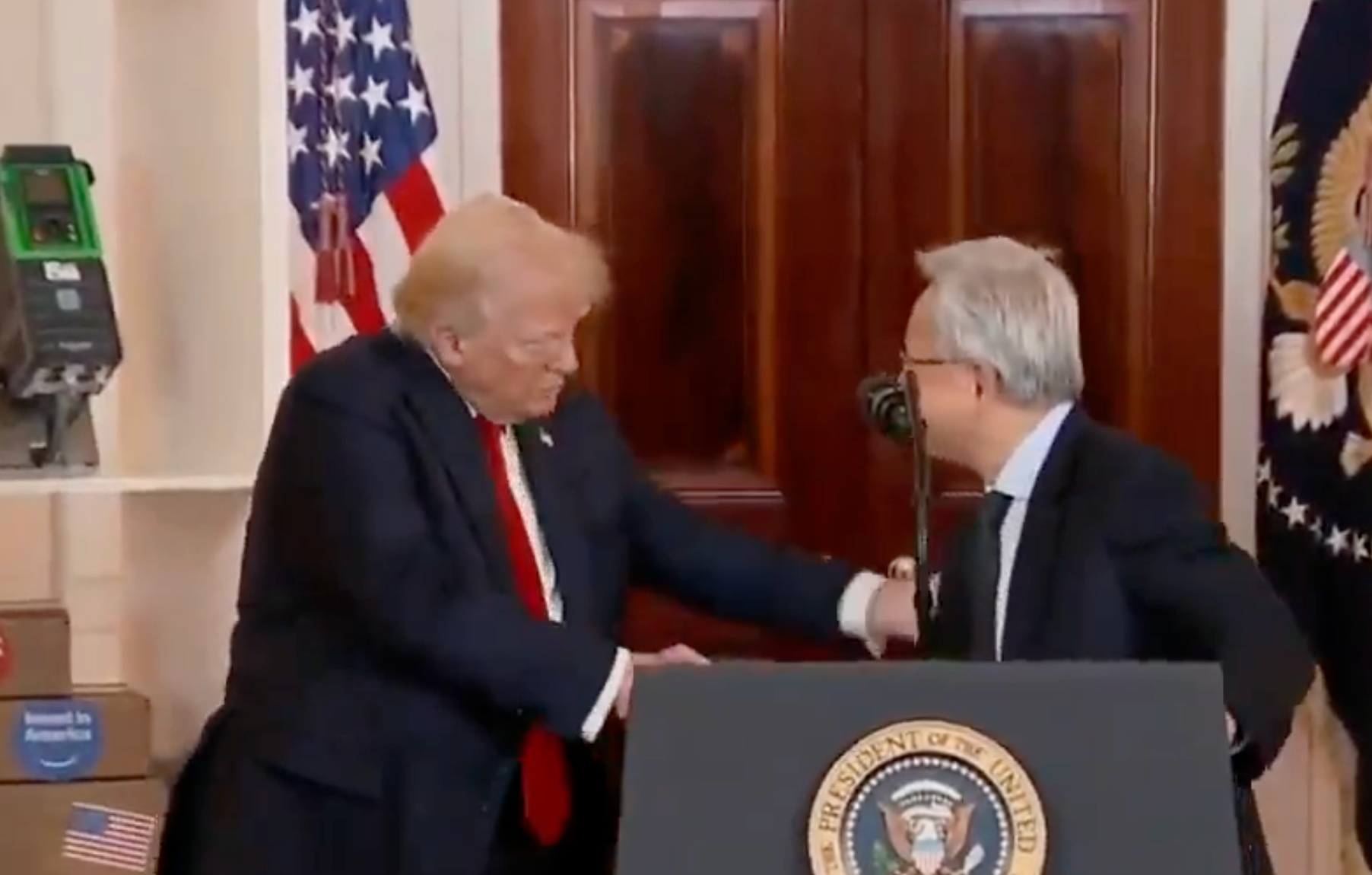
President Trump confirmed the terms of the unusual arrangement in a Monday press conference while noting that he originally wanted 20% of the sales revenue when Nvidia asked to sell the “obsolete” H20 chip to China. The president credited Nvidia CEO Jensen Huang for negotiating him down to 15%.
“So we negotiated a little deal. So he’s selling a essentially old chip,” Trump said.
Nvidia did not comment about the specific details of the agreement or its quid pro quo nature, but said they would adhere to the export rules laid out by the administration.
“We follow rules the U.S. government sets for our participation in worldwide markets. While we haven’t shipped H20 to China for months, we hope export control rules will let America compete in China and worldwide,” Nvidia wrote in a statement to the AP. “America cannot repeat 5G and lose telecommunication leadership. America’s AI tech stack can be the world’s standard if we race.”
AMD did not immediately reply to a request for comment.
Rep. John Moolenaar, the Republican chair of the House Select Committee on China, expressed concern over the deal.
“There are questions about the legal basis for doing so,” he said. “Export controls are a frontline defense in protecting our national security, and we should not set a precedent that incentivizes the government to grant licenses to sell China technology that will enhance its AI capabilities.”
The top Democrat on the panel also raised concerns over the reported agreement, calling it “a dangerous misuse of export controls that undermines our national security.”
Rep. Raja Krishnamoorthi, the ranking member of the House Select Committee on China, said he would seek answers about the legal basis for this arrangement and demand full transparency from the administration.
“Our export control regime must be based on genuine security considerations, not creative taxation schemes disguised as national security policy,” he said. “Chip export controls aren’t bargaining chips, and they’re not casino chips either. We shouldn’t be gambling with our national security to raise revenue.”
Derek Scissors, senior fellow and China expert at the conservative American Enterprise Institute, reiterated Moolenaar’s point about the constitutionality of the deal.
“There’s no precedent for this, probably because export taxes are unconstitutional, ” said Derek Scissors, senior fellow and China expert at the conservative American Enterprise Institute. “They call it a fee, but 15% of sales revenue is about a standard a tax as it comes. For this reason, I don’t think the ‘arrangement’ is at all durable. ‘’
“If it were to last, it has two possible implications. First, there’s a possible export tax that high-profile companies and goods must consider. Or the tax only applies in exceptional situations, such as changing export controls. Then we’d risk national security for the sake of tax revenue, which is effectively the same as cutting the defense budget,” Scissors said.
Back in July, Nvidia argued that tight export controls around their chip sales would cost the company an extra $5.5 billion. They’ve argued that such limits hinder U.S. competition in a sector in one of the world’s largest markets for technology, and have also warned that U.S. export controls could end up pushing other countries toward China’s AI technology.
Commerce Secretary Howard Lutnick told CNBC in July that the renewed sale of Nvidia’s chips in China was linked to a trade agreement made between the two countries on rare earth magnets.
Restrictions on sales of advanced chips to China have been central to the AI race between the world’s two largest economic powers, but such controls are also controversial. Proponents argue that these restrictions are necessary to slow China down enough to allow U.S. companies to keep their lead. Meanwhile, opponents say the export controls have loopholes — and could still spur innovation. The emergence of China’s DeepSeek AI chatbot in January particularly renewed concerns over how China might use advanced chips to help develop its own AI capabilities.
—-
Associated Press writers Josh Boak, Shawn Chen, Didi Tang and Paul Wiseman contributed to the reporting.