


By:Jennifer Shutt, Ariana Figueroa and Shauneen Miranda
WASHINGTON — Congress has roughly two months to find bipartisan agreement to curb rising health insurance costs if lawmakers want to avoid another government shutdown.
That herculean task would be difficult in the best circumstances, but is much more challenging after lawmakers spent the last 43 days criticizing each other instead of building the types of trust that are usually needed for large deals. Democrats maintained they wanted to address skyrocketing premiums for individual health care plans, while Republicans insisted those talks had to occur when the government was open.
At the same time, congressional leaders will try to wrap up work on the nine full-year government funding bills that were supposed to become law before Oct. 1 and weren’t included in the package that reopened the government.
Congress must pass all of those bills or another stopgap measure before the new Jan. 30 deadline, regardless of how well or disastrous talks on a health care bill turn out.
The two-track negotiations will push party leaders to compromise on issues they’d rather not, especially as next year’s November midterm elections inch closer.
Early signs were not good.
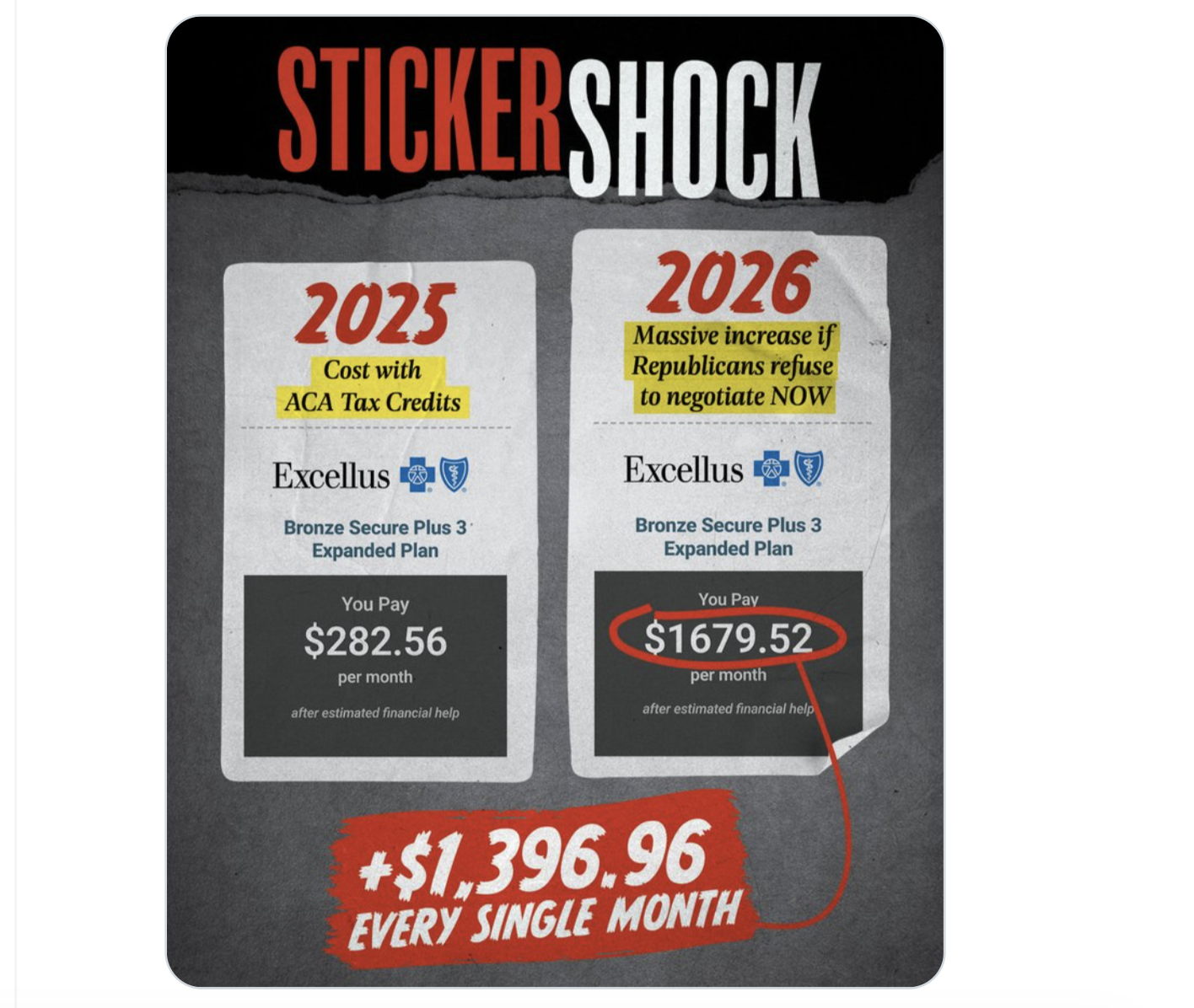
House Speaker Mike Johnson said during a Wednesday night press conference the enhanced Affordable Care Act tax credits set to expire at the end of the year are a “boondoggle” and that “Republicans would demand a lot of reforms” before agreeing to extend those in any way.
“We currently have 433 members of the House of Representatives. There’s a lot of opinions in this building. And on our side, certainly, a lot of opinions on how to fix health care and make it more affordable. I have to allow that process to play out,” Johnson, R-La., said.
While Senate Majority Leader John Thune, R-S.D., made a commitment to hold a vote on a health care bill before the end of December to conclude the shutdown, Johnson has avoided giving a timeline for when he would bring any similar legislation to the floor.
President Donald Trump, aside from throwing insults at Democrats, largely stayed on the sidelines of the shutdown fight, though he suggested the funds used for the tax credits should in some way go directly to individuals instead of large insurance companies.
Pessimism over progress
The shutdown highlighted the stark differences Republicans and Democrats hold on health care as prices for insurance continue to spike, forcing millions of Americans to choose between taking care of themselves and breaking their budgets, States Newsroom found in interviews with members of Congress.
GOP leaders held together throughout the funding lapse and didn’t negotiate on the expiring ACA marketplace tax credits, or anything else.
Now that it’s over, Republicans will need to put something forward.
Connecticut Rep. Rosa DeLauro, the top Democrat on the House Appropriations Committee, said her sense is that Congress will “probably be in the same place on January 30th that we are now.”
“We have two parties here, two sides,” DeLauro said. “In the past … we’ve had serious negotiation back and forth, and that’s what we need to do, and that’s not happening.”
While Republicans have unified control of government, major legislation needs the support of at least 60 senators to advance in that chamber. Republicans hold 53 seats at the moment, meaning at least some Democrats must support a bill for it to pass.
DeLauro did not rule out another shutdown, saying Democrats plan to take the next few months “one day at a time,” while closely watching what Republicans are willing to do on the nine full-year appropriations bills and health care costs.
Maryland Democratic Rep. Steny Hoyer, former House majority leader and a senior member of the Appropriations Committee, said Republican leaders keeping that chamber in recess for nearly two months leading up to and during the shutdown significantly delayed work on the full-year government funding bills.
Hoyer said that scheduling decision was a clear “indication they’re not interested in solving the problem.”
“If they were, they would have had members here working on appropriation bills,” Hoyer said. “And the only way you’re going to ultimately solve this problem is to pass appropriation bills.”
Hoyer said the real question facing Congress now isn’t whether there is time to work out agreement on the remaining nine government spending bills, but whether there’s a will to make the types of compromises needed.
Untangling spending bills
The spending package that reopened the government included three of the dozen full-year bills, funding the Agriculture Department, Food and Drug Administration, Legislative Branch, military construction projects and Department of Veterans Affairs.
The remaining appropriations bills will be considerably tougher to resolve, especially because the House and Senate have yet to agree on how much they want to spend across the thousands of programs. Trump proposed major cutbacks in multiple programs in his budget request earlier this year that Democrats have strongly resisted.
The Defense, Homeland Security, Labor-HHS-Education and State-Foreign Operations bills will be some of the more difficult to settle.
Congress could always lean on another stopgap spending bill to keep funding relatively flat for the departments and agencies not covered by a full-year bill before Jan. 30. But lawmakers will need bipartisan support to advance in the Senate.
Washington Democratic Rep. Pramila Jayapal, former chair of the Congressional Progressive Caucus, said Republicans don’t seem to grasp how much Americans are struggling with the cost of living, including for health insurance and health care.
“My constituents are already telling me that they’re making that choice between having health insurance or having a house to live in, and they’re going to choose the house,” Jayapal said.
Whether or not a partial government shutdown begins in early 2026 will likely depend on whether Republican lawmakers from swing districts force bipartisanship on a health care bill.
“I really don’t know,” Jayapal said. “I think it depends on these vulnerable House Republicans, who are not going to be able to go back to their constituents without telling them that they’ve done something on health care.”
Political juice and a backbone
Democratic Rep. Melanie Stansbury of New Mexico said she wouldn’t be surprised if Congress is unable to strike a deal on government funding and winds up in a partial shutdown by February.
“Do I think that the Republicans have the political juice to get … the rest of their appropriation bills across the finish line and a health care deal? No,” Stansbury said.
She added that she hopes a handful of Republicans decide to join Democrats on the discharge petition bill that would force a floor vote on a bill to extend the ACA marketplace subsidies for three years.
“We gotta find a few brave Republicans who still have a backbone and some guts to stand up to this administration and actually care for their constituents,” Stansbury said.
But any bipartisan deal to extend those health care tax credits seems fraught, as House Minority Leader Hakeem Jeffries slammed Republicans as having “zero credibility on this issue.”
He pointed to Republicans trying several times to repeal the Affordable Care Act, including their last attempt in 2017, when GOP Sens. Lisa Murkowski of Alaska, Susan Collins of Maine and the late John McCain of Arizona crossed party lines to vote against repealing the 2010 law.
“There’s no evidence that they’re serious about extending the Affordable Care Act tax credits,” Jeffries, of New York, said. “Republicans have zero interest in fixing the health care crisis that they’ve created.”
‘No point in taking 41 days to cave’
When Democrats controlled both chambers, temporary health care subsidies were originally passed as part of the COVID-19-era American Rescue Plan in 2021 for two years.
With Democrats still controlling both chambers, lawmakers approved the Inflation Reduction Act, the 2022 signature climate policy bill from the Biden administration, that extended those health care subsidies for three years, expiring at the end of December 2025.
The outcome of the just concluded shutdown is shaping some House Democrats’ views.
Virginia Democratic Rep. Bobby Scott said if there is a new shutdown come February, Senate Democrats will have to decide whether they’re going to “cave again, or at least engage in negotiations.”
“When the (Senate) Democrats say: ‘Our strategy wasn’t working,’ it wasn’t working because they assume you’re going to cave, which you just proved,” Scott told States Newsroom. “Their strategy worked — trying to get them to negotiate and talk to you doesn’t because they know you’re going to cave.”
Scott said “there’s no point in taking 41 days to cave,” pointing to the eight members of the Senate Democratic Caucus who broke ranks to advance and later approve the package to reopen the government.
“Why don’t you just cave right at the beginning, on February 2nd?” he said. “If the Republican strategy is: ‘We’re not going to negotiate at all because you’re going to cave,’ you have to show them that you’re not going to cave, then you can have a discussion.”
Scott said the same health care issues will still exist if nothing happens between now and the package’s Jan. 30 government funding deadline.
“By then, we’ll know that several million people don’t have health insurance, we’ll know that rural hospitals are beginning to suffer,” Scott said.
Delaware Democratic Rep. Sarah McBride said that “from today through November (2026) and after, we will continue to be talking about health care, to be fighting for health care.”
“I think what you’ve seen over the last several months, you will continue to see from us through November and then, God willing, once we’re in a majority, we’ll do all that we can to reverse these cuts and restore care and expand access to it,” she said.